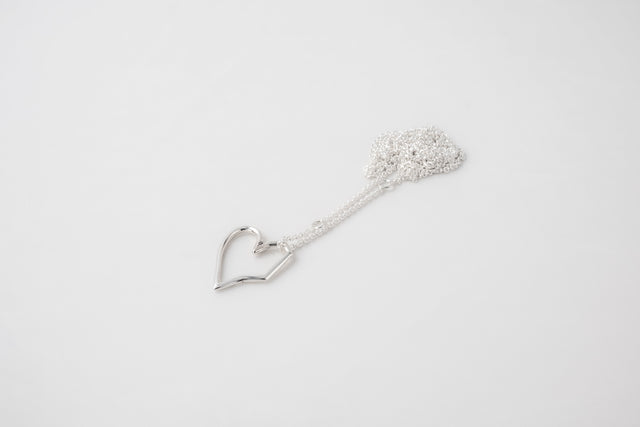
Most jewellery advice treats your hands and wrists as decoration surfaces. I treat them as architecture. This guide is the daily layering system I built for STRUGA clients — what to wear, what to skip, and how mens rings, chains, and bracelets work together when the goal is everyday quiet rather than weekend statement.
- Anchor: one heavy ring from BRUTALISM or THORN. Catalogue rings 2.1–24.0 g by size, median 7.0 g at size 18.
- Limit: two rings per hand, one bracelet per wrist, one chain. Six pieces.
- Chain sizes: 40, 45, 50, 75 cm. Everyday 45–50.
- Silver stays on in salt water, sweat, shower and sleep.
- Bracelets and chains of 45–95 g are for occasions.
- The set beds in over six to twelve months.
What "everyday jewellery" actually means
The phrase suggests something simple, replaceable, low-stakes. The pieces I make are the opposite — heavy, deliberate, built to last decades. But the wearing protocol is everyday. The pieces should disappear into your routine, not announce themselves every time you reach for a coffee cup. The architecture should register on a second look, not a first one.
Everyday wear is not about minimalism for its own sake. A single brutalist ring in heavy silver registers as more deliberate than three dainty pieces in different metals. Mass + restraint = quiet authority. That is the equation I designed STRUGA around.
One point of fact, because it decides how the set looks in a year: STRUGA silver arrives bright and darkens on the wearer. That is Living Silver — a property, not a finish. Seventeen pieces of the 134 in the catalogue are blackened at the bench, and all of them live in the RITUAL world. Everything else you see dark in photographs got there by being worn.
The daily layering system — how to build it
Three positions on the body, three rules each. Memorise the rules and you will not have to think about jewellery again — the layering becomes automatic.
Position 1 — hands (rings)
For mens rings as everyday wear, the system is:
- Anchor ring. One heavy ring in your dominant family — BRUTALISM or THORN. BLADE carries no rings at all; that family works at the wrist and at the neck. Worn on the ring or middle finger of your dominant hand. This is the piece that registers as architecture. The nine rings in the catalogue run 2.1–24.0 g — weight follows the size, and at size 18 the median is 7.0 g; the two BRUTALISM rings go from 9.6 g in size 15 to 24.0 g in size 22. Stays on day and night.
- Wedding band or partner band. Worn on the traditional finger. If the relationship has a band, this position is fixed. If not, leave it open or use it for a second piece in a different family.
- Optional second piece. Index finger or pinky. Lighter mass, different family from the anchor. Only if the day calls for it.
Two rings on each hand maximum for daily wear. Three or more reads as costume. Heavier rings work better than multiple small ones — mass is more confident than count.
Position 2 — wrists (bracelets and watches)
- Watch on the dominant or non-dominant wrist. Either works. Strap colour and finish should not fight the silver — black, dark brown, charcoal, or stainless steel all read fine with silver that has taken its patina. Avoid bright polished steel watches if you wear a darkened silver bracelet on the same arm.
- One bracelet on the opposite wrist. A heavy chain, a cuff, or a band in the BLADE language — the fourteen bracelets in the catalogue run 2.0–95.2 g, median 17.0 g. Single piece, no stacking. Cuffs work well because they sit at a fixed position; chains move and can clash with shirt cuffs.
- Optional second piece. Only if the bracelet position is held by something thin and the day allows for it.
Watch on one wrist, bracelet on the other. Stacking three bracelets on a single wrist reads as decorative. The silver is the statement — it does not need backup.
Position 3 — neck (chains and pendants)
- One chain at most. Single chain in heavy silver. The catalogue sizes are 40, 45, 50 and 75 cm: 45–50 cm is the everyday range, 75 cm is the long one. Worn over or under the shirt depending on weather and event.
- Pendant optional. If the chain has a pendant, the pendant is the focal point. If not, the chain itself is the piece.
- Second chain rare. Only when the chains are deliberately layered in different lengths — 45 cm and 75 cm, for example. Two chains at the same length reads as accidental.
Avoid pendants that compete with the rings. If your anchor ring is heavily textured, keep the pendant geometric. If the rings are clean planes, the pendant can carry more visual weight.
Mens rings as everyday wear — the specifics
Mens rings are the position most people get wrong. The advice online says "keep it simple, one ring, classic band." That advice is correct for someone who does not know what they want. For someone building a personal language, the advice is too cautious.
A heavy silver ring is everyday-appropriate in any context I have seen — boardroom, gym, dinner, travel, sleep. The piece reads as deliberate rather than decorative. Worn alone, it is quiet. Worn with a watch and a single chain, it is a system. Worn with a wedding band, it is two pieces of architecture in conversation.
What does not work as everyday: the heaviest links — the 85.0 g BLADE big-links bracelet, the 95.2 g carabiner cross, the 80.0 g BLADE choker — stone-set pieces, and designs with sharp protrusions that will catch on cuffs and pockets. Save those for occasions. Daily wear is about pieces that move with you, not against you.
Brutalist + minimalist crossover
The visual language of STRUGA is brutalist — heavy mass, raw planes, architectural geometry. The wearing language I recommend is minimalist — fewer pieces, more weight per piece. The combination is what makes the system work.
A brutalist ring worn alone reads as minimalist on the hand. The mass of the piece does the work that three smaller pieces would attempt. The negative space around the ring — the bare fingers, the unjewelled wrist — is part of the composition. This is the same logic as architectural minimalism: the empty floor is what makes the column register.
Pair this with neutral clothing — black, charcoal, navy, deep brown, white. Loud clothing fights heavy silver. Quiet clothing lets the silver register. This is not about being boring; it is about controlling where the eye goes. The piece should be the punctuation, not the sentence.
Style by occasion — what changes
Daily — work, errands, casual
Anchor ring, watch, bracelet, optional chain under the shirt. Five pieces total maximum. Quiet, consistent.
Evening — dinner, events, dates
Same baseline. If the event allows it, surface the chain over the shirt. Add a second ring on the index finger if the look needs more weight. Six pieces maximum.
Travel
Reduce. Anchor ring, watch, bracelet. Skip the chain unless you wear it under everything. Three pieces. Less to lose, less to take off at airport security.
Beach, outdoor, active
Just the rings. Silver is fine in salt water and sweat. Take off bracelets and chains if they will catch on equipment. Anchor ring and wedding band. Two pieces.
Sleep
Whatever you wore that day. Silver does not need to come off. The exception is rings with sharp protrusions that can catch on bedding. Most STRUGA pieces are designed to be sleep-compatible.
Common everyday-wear mistakes
Mixing metals badly
Mixing silver and gold in everyday wear is fine if the proportions are deliberate. One gold piece + multiple silver pieces reads as intentional. One silver piece + one gold piece + one steel piece reads as accidental. Pick a dominant metal and let the second metal play a supporting role.
Over-stacking
Three rings on one hand, two bracelets on one wrist, two chains, watch — the eye does not know where to land. The pieces stop reading individually. Reduce to the daily layering system above.
Wearing pieces meant for occasions
If you bought a ring for special events, do not wear it daily. Daily wear is the pieces that disappear into routine — the heavy anchor, the simple band, the worn-in bracelet. Save the high-statement pieces for moments that match.
Switching pieces too often
The point of everyday jewellery is patina, history, the slow accumulation of how you have lived. Pieces gain meaning by being worn. Rotating through different rings every week erases that. Pick the daily set, wear it for a year, evaluate.
Ignoring fit
A ring that is loose will rotate, scratch, eventually be lost. A bracelet that is too tight will leave marks. A chain that is too short rides up the neck. Fit is not optional. If a piece does not fit, it is not in the daily rotation.
Building the daily set — practical advice
If you are starting from zero, here is the order I recommend.
First piece — anchor ring. One heavy ring in the family that matches your aesthetic. BRUTALISM if you respond to architecture — the two rings there are 9.6 g each. THORN if you want organic edge — one ring, 4.7 g. If neither is it, the anchor is a commission. This piece will be the foundation of everything else. Spend more here than you think you should — this is the piece you will wear every day for years.
Second piece — bracelet or chain. One supporting piece. Bracelet if you do not currently wear chains. Chain if you do not currently wear bracelets. Match the family of the anchor ring or pick a different family for contrast — both work, depending on whether you want consistency or conversation.
Third piece — second ring. Optional. Add only if the daily set still feels under-built after the first two pieces have settled in.
The set takes six to twelve months to fully feel right. The pieces need to bed in. The patina needs to develop. The fit needs to become automatic. Patience here is not a weakness — it is the entire point.
In short — the everyday set in numbers
| Everyday rule | The number from the catalogue |
|---|---|
| Anchor ring | BRUTALISM — two rings, 9.6–24.0 g by size; THORN — one, 4.7–12.7 g. Nine rings in all, 2.1–24.0 g, median 7.0 g at size 18 |
| Rings on one hand | Two. Three and more reads as costume |
| Bracelet | One per wrist. Fourteen in the catalogue, 2.0–95.2 g, median 17.0 g |
| Chain | One. Sizes 40, 45, 50 and 75 cm; 45–50 cm is the everyday range |
| Pieces in total | Six across hands, wrists and neck; five is the working baseline |
| Not for daily wear | The heaviest links of 45–95 g, stone-set pieces, sharp protrusions |
| Finish | Living Silver by default — it arrives bright and darkens on the wearer. Blackened at the bench: 17 pieces of 134, all in the RITUAL world |
| Water, sweat, sleep | Silver stays on. The exception is sharp protrusions that catch on bedding |
| Bedding in | Six to twelve months of continuous wear |
Read more on STRUGA wearing principles
If you are building your daily set, the next reads are the sterling silver guide for 2026 for material context, the oxidised silver mens rings catalogue for ring choices, the buy silver jewellery overview for the full catalogue, and the oxidised silver care guide for keeping the pieces sharp. If you are commissioning a custom anchor ring, see design your own ring or custom jewellery Bali. For relationship-grade pieces, see proposal rings or dark union. For gifts, the gift from Bali page. The STRUGA origin story covers the philosophy underneath all of it.
Frequently asked questions
Didn’t find the answer — write to us, we reply personally.
Ask a question →01Can I sleep with my silver on?+–
Yes. Silver is durable and the metal does not need to come off for rest. The exception is pieces with sharp protrusions that can catch on bedding or skin.
02Can I work out with silver jewellery?+–
Yes. Sweat is fine. Salt is fine. Rinse with fresh water afterwards if you remember. Avoid pieces that will catch on barbells or grip equipment — for those workouts, leave the rings off and keep just a chain or bracelet.
03Can I wear silver in the shower?+–
Yes. Soap and water do not damage silver. Dry the pieces afterwards.
04How many pieces is too many for daily wear?+–
Six pieces total maximum across hands, wrists, neck. The system in this guide is five pieces (anchor ring, wedding band, watch, bracelet, chain) plus an optional sixth for evenings.
05What if I work in a conservative environment?+–
Heavy silver, dark with wear, reads as deliberate, not decorative. A single brutalist ring is appropriate in any business context I have seen. Skip the chains over the shirt; keep the bracelet visible only when the watch is uncovered. The system adapts down without changing.
06Can I wear different silver pieces from different brands?+–
Yes, but the visual language has to align. Mixing patinated STRUGA silver with bright polished silver from another brand creates contrast — not always bad, but it has to be deliberate. The family logic of each piece should resonate, not fight.
07How long until the daily set "feels right"?+–
Six to twelve months of continuous wear. The pieces patina, the fit becomes automatic, the layering becomes invisible to you. That is when the system is working.