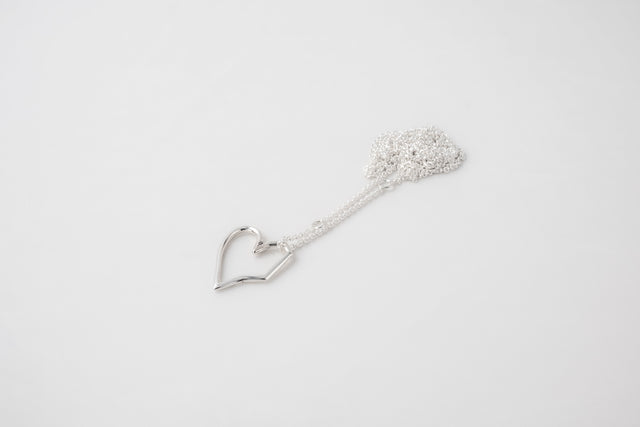
Rock Crystal Jewelry in Silver
Rock crystal is clear quartz — silicon dioxide, hardness 7, density 2.65 g/cm³. A natural stone, not glass and not the leaded «crystal» of glassware. STRUGA sets it as geology: the transparent crystal and the trace of its growth, kept wild rather than cut for shine.
Rock crystal is clear quartz — a natural silicon-dioxide crystal, not glass and not the leaded «crystal» of glassware.
By the numbers: SiO₂, Mohs hardness 7, measured density 2.65 g/cm³, refractive indices 1.544 and 1.553.
STRUGA takes rock crystal wild and uncut: phantoms, rutile threads and growth zones stay as they grew.
Quartz lives in the AMULET family of the RITUAL world; STRUGA has no separate rock-crystal collection.
Four quartz pieces are in the catalogue right now, each one the only one of its kind — clear, brown and two green.
The stone is set in 925 silver with no rhodium plating — Living Silver, which starts light and darkens with wear.
Rock crystal at STRUGA is material, geology and a cultural reference — no promise of energy, protection or effect.
A specific crystal not in stock is sourced to order through Custom Order.
- What rock crystal is
- Rock crystal in numbers
- Rock crystal and the crystal of glassware
- Why clear, not sparkling
- What you see inside the stone
- Earrings, pendants and other forms
- Quartz in the catalogue right now
- How to choose rock crystal
- How to care for it
- FAQ
What rock crystal is
Rock crystal is clear quartz. Not glass, not the leaded «crystal» of glassware, but a natural silicon-dioxide crystal that grew colourless and clear inside the rock. The same mineral family as smoky quartz or citrine, only without the trace element that would have given it colour.
Quartz is one of the most common minerals on earth, and that is exactly why the clear one is worth looking at closely: the mineral is ordinary, a large clean crystal is not. Inside the stone you can read how it grew — phantoms, threads of rutile, fine fractures, zones of clear and clouded. STRUGA takes rock crystal wild, uncut. It is a crystal in its natural form, not a polished insert: the ridges, the growth chips and the glass of the clear zones stay as they are.
Rock crystal in numbers
| Property | Value |
|---|---|
| Chemistry | SiO₂ — silicon dioxide, with traces of other elements |
| Mohs hardness | 7, variable by direction and form |
| Density | 2.65 g/cm³ measured; 2.66 g/cm³ calculated |
| Refractive indices | ω = 1.544, ε = 1.553, uniaxial positive |
| Crystal system | Hexagonal, point group 32 |
| Colour and lustre | Colourless to white; vitreous lustre, dull when massive |
| Polymorphs | Cristobalite, tridymite, coesite, stishovite — the same SiO₂ in other structures |
| Fracture | Conchoidal; cleavage rarely observable and poor |
| Stability | Low quartz is stable below 573 °C |
| In a STRUGA object | Set in 925 silver, on a 75 cm chain in the Classic Amulet necklaces |
Mineral values: Handbook of Mineralogy, quartz (Mineral Data Publishing). Chain length and setting: the STRUGA catalogue.
Two of those numbers matter when the stone is worn rather than studied. Hardness 7 is high enough that everyday dust, which is largely quartz itself, will not scratch it easily — and low enough that a harder stone will. And the poor cleavage means a wild crystal breaks along a conchoidal, shell-like curve rather than splitting cleanly, which is why the broken faces of a raw crystal look the way they do.
Rock crystal and the crystal of glassware
The same word covers two different materials, and the confusion is worth undoing once. Rock crystal is a mineral that grew in rock. The «crystal» of decanters and chandeliers is glass, made in a furnace, and in Europe the word on the label is regulated by composition.
| Rock crystal | Lead crystal glassware | |
|---|---|---|
| What it is | Natural quartz crystal | Glass melted with metal oxides |
| Composition | SiO₂ | At least 24% lead oxide for «lead crystal»; at least 30% for the highest grade |
| Density | 2.65 g/cm³ | At least 2.90 g/cm³; at least 3.00 for the highest grade |
| Refractive index | 1.544 to 1.553 | At least 1.545 |
| How it got its shape | Grew that way | Cast and cut |
Glassware thresholds: Council Directive 69/493/EEC, Annex I. Mineral values: Handbook of Mineralogy.
Read the two columns together and the difference is not the sparkle — the refractive indices nearly coincide. The difference is the lead and the labour: glassware earns its name by weight of lead oxide and by being cut, while a rock crystal earns nothing and simply grew. STRUGA works with the second one, and leaves the cutting undone.
Why clear, not sparkling
A cut stone has its facets sliced to break light and throw it back as sparkle. STRUGA’s rock crystal does not throw light back — it passes light through and holds it inside. The clarity here is not a display-case shine but what you see through the stone: its own structure, and the silver behind it.
Quartz lives in the AMULET family — the brand’s RITUAL world. «Amulet» here describes the object and its symbolic weight for the wearer; STRUGA promises no stone energy, no protection, no healing. Rock crystal is material, geology and a cultural reference, not a curative property. The 925 silver around it works like host rock: it holds the clear crystal and gives it a ground to read against.
What you see inside the stone
A wild crystal is not empty. What is read as a flaw in a cut stone is, here, the record of how it grew.
Phantoms
A phantom is the ghost of an earlier crystal inside the present one: growth paused, a thin layer of another mineral settled on the faces, growth resumed around it. The old outline stays visible in the clear body — a smaller crystal drawn inside the larger one.
Rutile and other threads
Fine threads of rutile grow through the quartz while it forms, golden or dark, sometimes in one direction, sometimes as a tangle. They are a second mineral captured whole, not a crack.
Growth zones and fractures
Clear and clouded zones alternate where the conditions changed. Fine internal fractures catch light as flat planes. Together they make a pattern that is different in every stone, which is why no two of these objects can be the same.
Earrings, pendants and other forms
STRUGA has no separate rock-crystal collection — quartz arrives in the AMULET family and to order. Here is where to go by Atlas nodes and live collections:
- Rock crystal earrings: clear quartz in silver on the ear — the form is built around the stone through the AMULET family and Custom Order, usually around a specific crystal.
- Pendant: the Amulet node — the AMULET family, where a wild stone becomes a pendant on a chain; inside it Classic Amulet, Thorn Amulet and quartz amulets.
- The matter of the stone: the Stones node — how STRUGA reads quartz as material and geology, with no promise of effect.
- The whole crystal family: the AMULET collection — quartz and other wild stones in 925 silver; a kindred selection is Tourmaline Jewelry.
- A specific rock crystal: if the crystal you want is not in stock, it is sourced to order through Custom Order and set in silver.
One rule runs through every form: the stone is left clear, the way it grew. The silver does not compete with the crystal for light — it holds it and steps back.
Quartz in the catalogue right now
Four quartz objects are live at the moment, all of them Classic Amulet necklaces: a raw stone in a silver frame on a 75 cm chain. Each is an exact piece — one stone, one object, no second copy. Only the first is rock crystal in the strict sense; the other three are quartz of another colour, and they show what the same setting does with a different stone.
- Clear quartz: Classic Amulet Necklace — Clear Quartz. Rock crystal itself: a transparent raw crystal in a silver frame.
- Brown quartz: Classic Amulet Necklace — Brown Quartz. The same mineral carrying colour — smoky, warm, denser to the eye.
- Green quartz: Classic Amulet Necklace — Green Quartz, 9 g, unisex.
- Green quartz, second variation: Classic Amulet Necklace — Green Quartz (alt), 40 g in total — a different crystal, a different weight, a different silhouette from its sibling.
Prices and availability live on the object pages, because each of these is a single stone and the catalogue changes as pieces leave. If none of the four is the crystal you had in mind, the stone is sourced through Custom Order.
How to choose rock crystal
The choice goes by the crystal itself. You look at clarity: where the stone reads straight through, where there is mist inside, a phantom or a thread of rutile. Clean rock crystal passes light evenly; inclusions give a pattern that is different in every stone. No two wild crystals are alike — each grew on its own, so each piece is the only one of its kind.
- Clarity: where the stone reads straight through, and where it clouds.
- What is inside: a phantom, a thread of rutile, a growth zone — the pattern is different in every crystal.
- Scale: the stone is matched to the person, not to a size chart.
- Availability: each of the four live pieces is a single stone; if none of them fits, the crystal is sourced to order.
Stone size is matched to the person — to the finger in a ring, the chain length in a pendant, the ear in an earring. If the rock crystal you want is not in stock, it is sourced to order through Custom Order: STRUGA works with many kinds of stone. Then comes the setting in 925 silver, which starts light and darkens with wear, so the clear quartz keeps its ground as the metal changes.
How to care for it
The stone and the metal age differently, and that is the whole of the care.
- The quartz does not change. At hardness 7 it outlasts household dust and ordinary wear.
- What dulls it is film, not damage — soap, cream and skin oil settling into the growth zones.
- Cleaning: warm water, a soft brush, drying with a cloth. That returns the clarity.
- Storage: keep the piece apart from other jewellery. Quartz at hardness 7 is harder than silver, so a stone loose in a box will mark the metal around it.
- What to avoid: knocking the stone against a harder stone or a hard edge. The conchoidal fracture means a sharp blow chips a shell-shaped flake rather than a clean line.
The silver does change, because it is 925 with no rhodium plating. It arrives light and darkens with air and skin; the raised edges stay brighter where they rub, the recesses go dark. That patina is a property, not a fault, and it is reversible — a silver-cleaning liquid returns the fresh metal whenever the owner wants it back.
Frequently asked questions
Didn’t find the answer — write to us, we reply personally.
Ask a question →01Is rock crystal quartz or glass?+–
Quartz. It is a natural clear crystal of silicon dioxide, the same mineral as smoky quartz but without colour. The «crystal» of glassware is leaded glass and has nothing to do with the stone.
02What is the difference between rock crystal and lead crystal?+–
Origin and composition. Rock crystal is natural quartz, SiO₂, with a density of 2.65 g/cm³. Lead crystal is glass that must contain at least 24% lead oxide and reach a density of 2.90 g/cm³ to carry the name in the EU. One grew, the other was melted and cut.
03Is there a clear quartz necklace at STRUGA?+–
Yes — the Classic Amulet Necklace with clear quartz: a raw transparent crystal in a silver frame on a 75 cm chain. It is an exact piece, so there is one of it; three more quartz necklaces in brown and green are live alongside it.
04How is STRUGA’s rock crystal different from a cut stone?+–
By the cut. A cut stone has its facets sliced for sparkle; STRUGA leaves the quartz in its natural form — you can see the growth, the phantoms and the clarity of the crystal. The stone is presented as geology, not as the shine of a diamond.
05Does rock crystal scratch or break easily?+–
It is hardness 7 on the Mohs scale, so ordinary dust and daily wear do not mark it; a harder stone or a hard edge can. Quartz has poor cleavage and a conchoidal fracture, which means a sharp knock chips a shell-shaped flake instead of splitting the crystal.
06Are there rock crystal earrings or a pendant?+–
Quartz arrives in the AMULET family — STRUGA has no separate rock-crystal collection. The pendant lives in the Amulet node and the AMULET collection; an earring built around a specific crystal goes through Custom Order.
07Is rock crystal about energy or protection?+–
No. At STRUGA a stone is material, geology and a cultural reference. The word «amulet» describes the symbolic weight of the object for the wearer, not a promise of energy, protection or healing.
08Can I order a piece with a specific rock crystal?+–
Yes, through Custom Order. If the crystal you want is not in stock, STRUGA sources it to order and sets it in 925 silver.