Alternative Engagement Rings — Beyond the Diamond Solitaire (2026 Guide)
Alternative Engagement Rings — Beyond the Diamond Solitaire (2026 Guide) | STRUGA
An alternative engagement ring is anything that walks away from the De Beers playbook — no white diamond, no yellow gold, no tiffany-style six-prong. The category covers non-diamond stones, dark silver, brutalist forms, plain bands, oxidized finishes, and one-of-one author pieces. This guide explains what an alternative ring actually is, why so many couples now choose one, and how to pick the form, metal, and stone that fits the person who will wear it.
Key takeaways
- "Alternative" means non-traditional — non-diamond stone, non-gold metal, non-classical form, or all three.
- Sapphires, moissanite, salt-and-pepper diamonds, lab-grown stones, and meteorite are the most common stone alternatives. Black, dark, oxidized, or brutalist silver bands are the most common form alternatives.
- A growing share of US couples now choose a non-traditional ring. The shift is generational and budget-driven, not a passing trend.
- STRUGA approaches alternative engagement through dark union (paired rings) and proposal rings — silver-first, dark-finish, sculptural forms with no center-stone obligation.
What counts as an alternative engagement ring?
A traditional American engagement ring has three things: a round white diamond, a yellow or white gold band, and a solitaire setting (one center stone, four-to-six prongs). Anything that drops one of those three pillars is "alternative."
The phrase covers a lot of ground. A salt-and-pepper diamond on rose gold is alternative. A plain oxidized silver band with no stone at all is alternative. A brutalist sculptural ring in dark sterling — what we make at STRUGA — is alternative. So is a cluster of small lab-grown stones, a single sapphire, a meteorite inlay, or a vintage 1920s art deco piece your grandmother passed down.
The label is loose on purpose. What matters is the choice — the couple opted out of the script that says "round white diamond on yellow gold" and chose something that fits them instead.
Why alternative rings have become the new normal
Three forces are pushing the shift, and none of them are temporary.
1. The diamond mythology lost authority. The "diamond is forever" campaign ran from 1947 to roughly 2010. It built an industry on the idea that a man should spend two-to-three months' salary on a round white stone or the relationship would not be real. That story is over. Younger couples grew up with the internet, with research, with documentaries on the diamond trade, with lab-grown stones that test identical to mined ones at one-third the price. The mythology no longer works on people who can search the answer in three seconds.
2. Budgets are spent on experiences, not symbols. A US couple now spends a median $5,500 on an engagement ring, per the Knot's 2024 survey — down from $7,800 in 2019 in inflation-adjusted dollars. The savings go to the wedding, the honeymoon, a house down-payment, or simply not being in debt. An alternative ring — silver instead of gold, moissanite instead of diamond, sculptural instead of solitaire — frees three-to-six thousand dollars without weakening the proposal.
3. Personalization replaced status signaling. The point of a luxury ring used to be that other people would recognise the value. The point of a contemporary ring is that the wearer recognises themselves in it. That re-orients the search completely: away from what looks expensive, toward what looks like them.
The five categories of alternative engagement ring
Most alternative rings fall into one of five families. Many overlap — a brutalist silver ring with a salt-and-pepper diamond hits three categories at once.
1. Non-diamond center stones
The simplest alternative: keep the solitaire silhouette, swap the stone. The most common choices are sapphires (any colour, including the classic blue, teal, peach, and grey), moissanite (a lab-grown silicon carbide that tests near-identical to diamond at one-tenth the price), salt-and-pepper diamonds (mined diamonds with visible inclusions, embraced rather than hidden), morganite (pink beryl, soft and warm), and lab-grown diamonds (chemically identical to mined, 30-50% cheaper). The setting can stay traditional; the stone alone changes the character of the ring.
2. Non-traditional metals
The second alternative: keep the stone, change the metal. The classical pair is diamond on yellow or white gold. Alternative metal choices include rose gold (warmer, cheaper than yellow), platinum (cooler than white gold, denser, more durable, more expensive), sterling silver (a fraction of gold's price, with a darker tonal range, and the only metal that takes a deep oxidized black), and titanium or tantalum (industrial, dark, scratch-resistant). At STRUGA we work almost exclusively in 925 sterling silver — it is the metal that holds darkness, finish texture, and brutalist form better than any other.
3. Dark, oxidized, or blackened finishes
This is where the silhouette moves furthest from the conventional sparkle. A dark engagement ring is silver (or gold) treated with oxidation to produce deep black, charcoal, or graphite tones across the surface. The stone, if there is one, often sits flush or under a bezel rather than raised on prongs. The whole ring reads as a sculptural object rather than a frame for a stone. Our STRUGA's dark union page is the central reference for this approach across rings, bands, and proposal pieces.
4. Sculptural and brutalist forms
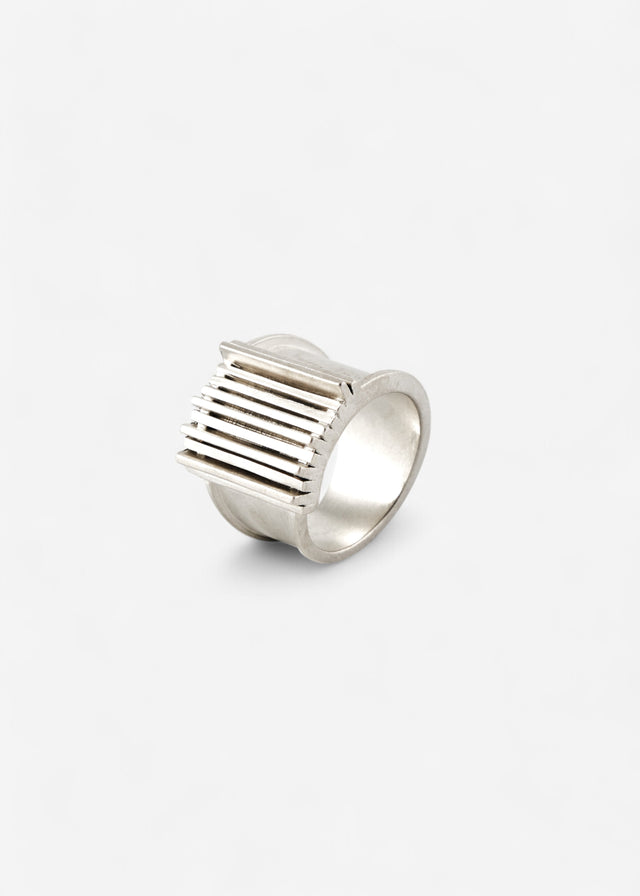
Brutalist engagement rings borrow from mid-twentieth-century architectural language — raw concrete, exposed steel, deliberately heavy proportions. In a ring this means thick wide bands, asymmetric profiles, hammered or fused texture, sometimes no stone at all. The ring is the object. blade jewelry and the codex collection world at STRUGA both pull in this direction. A brutalist piece reads as serious adornment rather than decorative jewellery, which suits a certain kind of person and their partner exactly.
5. Plain bands without a center stone
The most radical alternative: a single ring with no center stone at all. A wide oxidized silver band. A hammered platinum cigar band. A pair of fused silver rings stacked. The "engagement" is signalled by the act of giving, not by a gemstone. This option has grown fastest among couples who plan to have one ring rather than the engagement-ring-then-wedding-ring sequence. For more on that decision see engagement ring versus wedding ring.
Choosing the right alternative — five practical questions
The wrong way to pick an alternative ring is to look at trend articles and copy. The right way is to answer five questions about the person who will wear it.
What does she actually wear day to day?
Open her jewellery drawer. If there is a lot of warm gold, lean rose or yellow. If there is a lot of cool silver, lean platinum or oxidized sterling. If she wears almost nothing, a plain wide silver band will look more like her than a one-carat solitaire. The ring should disappear into the rest of her aesthetic, not contradict it.
Does she want a stone — and if so, what kind of stone?
Some women love the sparkle of a center stone. Some find it ostentatious. Some want a single small stone, almost hidden. Some want texture and metal, no stone at all. There is no neutral answer. Watch what she points to in shop windows or saves on Pinterest. If she sends you links to vintage cluster rings, do not buy a tiffany-style solitaire.
How does she use her hands?
A surgeon, a climber, a potter, a yoga instructor — all of them need a ring that does not catch on gloves, ropes, clay, or fabric. A high-set solitaire on a thin band will snag and bend within a year. A flush-set or bezel-set stone, or no stone at all, on a thicker band, will not. Our proposal rings page filters specifically for this — silver, low-profile, daily-wear durable.
Will she wear an engagement ring and a separate wedding ring, or one ring total?
The two-ring tradition is American by origin and not universal. Many European couples wear one band on the ring finger of the right hand from engagement onward — see which hand engagement ring traditions for the full geography. If she plans to wear one ring, the engagement ring is also the wedding ring, which changes how you weight stone-versus-band choices. If she plans to wear two, you can treat the engagement ring as the more decorative piece and let the wedding ring be plain.
What is the budget honestly?
The "two months' salary" rule is De Beers marketing from the 1930s. It has no other source. The honest budget is whatever you can spend without going into debt for years. An alternative ring is freedom from that rule — a beautifully made silver brutalist band with a small salt-and-pepper diamond can land at $400-$900 and look like a ring made for one specific person. A traditional one-carat diamond solitaire on platinum starts at $7,000 and ends well above $20,000. The two are not the same purchase.
STRUGA's approach to alternative engagement
STRUGA is a Bali-based author jewellery brand. Every piece is hand-cast in 925 sterling silver in our workshop in Gianyar regency and finished one by one — see our Bali silver guide for the full process. We do not make traditional diamond solitaires. We do make engagement rings — but they live inside a different aesthetic.
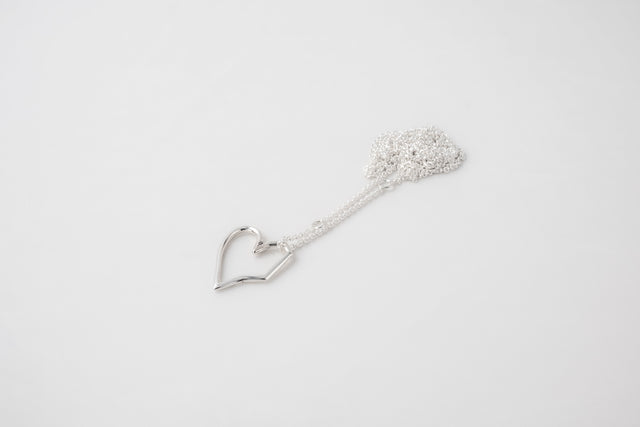
Dark Union is our reference page for couples choosing a dark, oxidized, brutalist, or sculptural alternative. The page collects rings from CODEX (classical with dark twist), Blade family (brutalist sculptural), and Heart and Thorn (smaller statement pieces). The shared logic: silver instead of gold, dark finish instead of high polish, sculpted form instead of prong-mounted stone.
Proposal rings is the filtered subset for the engagement moment specifically — pieces that work as a single ring (no separate wedding band needed) or as the more decorative half of a two-ring pair. They run $200-$1,200 in 925 silver, with options for a small flush-set stone if requested as custom work.
Dark Wedding is the wider category for couples planning a non-conventional ceremony — proposal ring, two wedding bands, one matching set. Many couples come for an engagement ring and stay for the bands.
What questions couples ask us most
Are silver engagement rings taken seriously?
Increasingly yes, especially in Europe and among design-aware couples globally. Silver was historically considered a "lesser" metal because gold was scarcer and heavier. That hierarchy made sense in 1850. In 2026, silver, gold, and platinum are all available; the metal you choose says something about your aesthetic, not your budget capacity. A well-made oxidized silver brutalist ring is a statement, not a compromise.
How long will an alternative ring last?
A 925 sterling silver ring with proper care lasts decades — many of our clients wear theirs daily for ten or more years. Silver is softer than platinum, slightly softer than 14k gold, and harder than 22k gold. It will scratch over time, which most owners come to like. An oxidized finish may wear off the high points within two-to-five years; we re-oxidize for free for STRUGA rings and most Bali workshops do the same. A plain polished silver ring needs a soft cloth wipe roughly monthly to stay bright. None of this is fragile.
Can I add a stone to a STRUGA ring later?
Yes, on most ring forms. We bezel-set or flush-set small stones (salt-and-pepper diamonds, sapphires, lab moissanite) into existing pieces in our Bali workshop. The fee runs $80-$300 depending on stone and setting. For full custom work — a stone selected first, ring built around it — start with the custom jewelry Bali page.
Do alternative rings hold value if I need to re-sell?
Less than mined diamonds in nominal terms, but the gap is smaller than people assume. A diamond engagement ring loses 50-70% of its retail price the moment it leaves the store, because retail markup is 200-400%. An alternative ring from a small workshop has lower markup (typically 1.5-3x material and labour cost), so the gap between purchase and resale is smaller. A well-made silver brutalist ring with a documented maker holds its position better than people expect. That said, an engagement ring is rarely bought to re-sell.
What if I propose with one ring and she wants something different?
This is fine and increasingly common. The proposal does not have to lock the ring choice for life. Many couples propose with a placeholder — sometimes a stand-in band, sometimes a first ring chosen by the proposer alone — and then the wearer chooses or co-designs the final piece together. STRUGA does this routinely as part of custom work: propose, then come to the workshop together (or remotely) to design the actual ring she will wear.
What styles of alternative engagement ring suit men?
Most of our engagement and wedding ring conversations are now with both partners, not just one. Men's alternative engagement rings — yes, the proposing-back trend is real and growing — usually go heavier and more brutalist. Wider bands, deeper oxidation, more sculptural form, no center stone. The Blade collection world specifically was built around this language. For more on the broader category see engagement ring types.
Where to start your alternative ring search
If you already know the direction — non-diamond stone, dark silver, brutalist form, plain band — start with the corresponding page on STRUGA. dark union — wedding rings covers oxidized and brutalist. Proposal rings filters for engagement-specific pieces. Dark Wedding covers the broader couple's-set scenario.
If you do not yet know the direction, start with our engagement ring types guide for the full taxonomy of forms (solitaire, halo, three-stone, cluster, brutalist, plain band, signet) and our Bali silver guide for the metal and craft context. Then narrow.
For one-of-one work — a stone, form, or finish that is not on the existing pages — the custom jewelry Bali page is the starting point. Most of our engagement rings end up at least partly custom, because the right ring for one specific person rarely sits exactly on a standard product page.
The point of an alternative engagement ring is the alternative. Choose it because she — or you, or both of you — want this specific object on this specific finger for the next several decades. The ring is small. The decision is not.
About STRUGA. STRUGA is a dark silver jewelry brand founded by Dmitry Strugovshchikov and Ekaterina Strugovshchikova, handcrafted with Balinese and international silversmiths. Every piece is 925 sterling silver, naturally oxidized or hand-patinated. The darkening is part of the design. It is a brutalist object that reacts and changes through contact with the environment and the wearer.