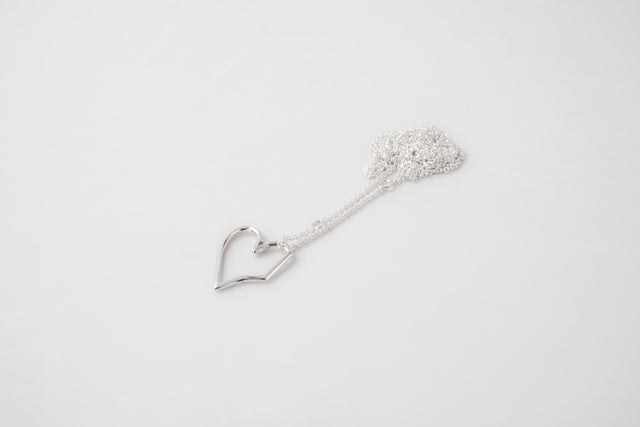
Parts of Four
Parts of Four is jewelry, objects, furniture, and sound by Evan Sugerman. The room you can walk into is in Paris. He lives in Bali, and the work is made there. The residence and the sound are shown on the brand’s own pages.
Updated 7 November 2026.
What does the designer say about himself?
Evan Sugerman talks about the work as a long attempt to know himself and to understand what love is. That is how he answered Alexandre Marain in the Vogue Hommes interview of 30 June 2020, when he was asked about the path.
He came to jewelry by accident and did not yet know where to go next. A piece seemed to him a small sculpture, architecture you can hold in the hand, and a way to pass on force at once. The name Parts of Four began as a note in a sketchbook: divide what you see into four parts. For the first years it was a note to himself. Later he says the whole brand stands on it.
On 24 November 2021, in a Behind the Brands conversation of fifty-one minutes, he shows the sheet where it was written. The first brand had stopped. For several years he did not believe the work would return. He drew belt buckles and wrote instructions to himself. One of them was: divide everything into four parts. He looked at the words and kept them as the name.
He calls himself an inventor more than an author. Growing a form out of his own thought matters more to him than decorating a person. The body gives the work a support. He leaves the meaning to the person who wears it: a Parts of Four piece can hold that meaning.
A year before that Vogue interview, on 1 April 2019 in VO+, he tells the same work through sound. A new collection answers the earlier ones. When he draws, he barely looks at other people’s pictures: it is too easy to start repeating them. Form arrives in silence, as a flash, or out of what has already been lived, closer to the way an engineer works. He compares the method to a modular synthesizer. The same forms are stacked, filtered, and tuned until the exact point is found.
What came before the brand?
In his profile he writes that from 1996 to 2000 he studied visual art at the University of California, Santa Cruz. There were installations, mechanical movement, and sound that answers what is happening nearby.
From 2003 to 2009 the same profile lists Ernte. The project card calls it “a moment in time, a meditation on cyberpunk and hard clothing.” In that same hour of 2021 he says Ernte ran for five or six years and fell apart. After university he could not earn a living from installations, and he followed a friend into clothing. That is how the first brand came together. Then he started a family and began to put himself back together.
The jewelry appeared by accident. By then he was already living in Bali. He moved there to make leather jackets: he had heard the place suited that work, and it did. He had not planned to stay. By November 2021 he had lived there for almost twenty years. When he arrived, cappuccino was made in one place, the salad was iceberg lettuce with mayonnaise, and rice fields lay all around. By the evening of that conversation the surroundings were already a noisy city.
In the 2020 interview he remembers that before his own brand he was entirely taken with Chrome Hearts. The first thing he wore himself was a necklace of tin discs on a chain of matte black faceted beads. He wore it every day for many years. Now he does not take off a heavy ring of two plates with a diamond. As a gift he chooses crystals and talismans. The most unusual piece of his own, he says, is the Pelican Skull pendant. In Paris, Jannah wore it.
He dresses in Rick Owens and Boris Bidjan Saberi. He names Alexander McQueen apart, for how far an artist is willing to go in clothing. A man, he says, should wear jewelry with confidence and skill, at ease with his own femininity.
The profile also records the work beside this. From January 2011 to September 2015 he, with others, conceived, developed, and produced the main jewelry line of Rick Owens. The same profile lists him as owner of Black Dove Manufacturing in Bali Province from January 2011. The Story shop in Okayama, on 9 June 2020, writes about that collaboration with Rick Owens.
Where does the brand come from, and where does it stand?
The about page was updated on 26 May 2026. On it Evan Sugerman is an artist from Los Angeles, and the brand was founded in 2011. Parts of Four makes jewelry, objects, furniture, and installations. The page talks about form, material, and how a piece is made. Form follows material: the material holds history and force. The aim is named outright: hard, dense, industrial shamanic tools. The jewelry on the page is shared by everyone and sits outside the season.
The company card writes its own year and its own address: founded in 2012, headquarters in Hong Kong, Cosco Tower, 183 Queen’s Road Central. There the brand belongs to the designer and to Damian Yurkievich, director and investor. The header of the personal profile gives the city as Paris. English is his native language. Indonesian is a working language.
In that same hour he tells how Damian entered the business. In the early years Evan brought a small collection to Paris and rented a room during fashion week. He began renting the room from Damian. For a couple of seasons Damian was the landlord. Then Evan offered him ten percent: to take on the import into Europe, the duties, and delivery to the buyer. One season passed that way, then another. The first truly large order for Parts of Four came from the shop LNCC. Evan names a sum of about twenty-five thousand. Damian looked at the order more coldly and was right. The shop did not pay. After that Evan gave him half. Damian, he says, is French and has long lived in Thailand, with his family. One place is farther out, in the jungle. The other is in Bangkok.
His personal page puts the city as Bangkok. There he is co-owner and director of Parts of Four from August 2013. He writes the places of that work as Paris, Bali, Bangkok, and Hong Kong. The same text gives the brand rooms in Paris and in Los Angeles. The feed pins the Los Angeles address to one evening: on 14 January 2017, the opening of a temporary EXALT point on Abbot Kinney. His company DYG Limited has stood in Hong Kong since September 2021. He writes that it is wholly his and is occupied with investments. The page also names Sciences Po.
Where can you walk in, in Paris?
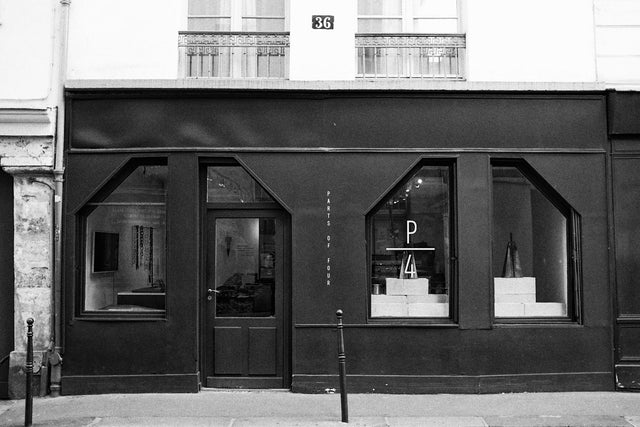
The only visit address on the site is 36 Rue Charlot, 75003 Paris. Monday to Saturday 10:00–13:00 and 14:00–18:45, Sunday 14:00–18:00. In the facade photograph the building is numbered 36, the window is dark, and in the glass a letter P sits above the numeral 4.

The same Rue Charlot stands on the company card beside Hong Kong, Bangkok, and Bali. By the published hours, you come to Paris. The shop list also includes Poison Drop in Dubai. By November 2021 this room was seven years old.
Before number 36, the room in this quarter had already moved. In September 2014 the Black Dove DYG showroom stands at 11 rue Debelleyme. In October the retail room is already at 18 rue Charlot, and the display is assembled by Crozon. In March 2015 a post writes of a new room with Lukas Machnik at 38 rue Charlot and of an opening in June. In the autumn the PAWAKA cocktail and opening are set at 36 rue Charlot: 3 October at six in the evening, the opening itself on 7 October. From January 2017 the posts name this number, and the site names it too. On 22 June they show a display there. During fashion week, 22–30 June 2021, appointments for the room are taken in person or on a screen.
Where are the pieces made?
On the about page, Bali appears in the shop list as one line, Laboutik.
Black Dove Manufacturing, the company from his profile, calls itself a design and production group in Bali. They grew Parts of Four from the start and developed pieces for other brands, among them Rick Owens. The company’s old site, saved in 2020, shows the portfolio. There are Rick Owens buckles and clasps from 2011, jewelry for his flagship shops, samples for the runway, and Parts of Four jewelry of its own, the 2013 and 2015 seasons. That address is an empty page now. From April 2013 the brand feed shows Rick Owens pieces made at Black Dove. On 6 March 2015 the words Bali and Black Dove stand side by side. On 18 September 2019 the feed thanks the first intern, @naula_studio, for work here in Bali.
The partner FOB Paris, on 20 February 2024, describes the Bali workshops as the place where pieces come out of raw material. The subject there is shared watches and jewelry. The Archive in San Francisco writes that the base is now in Bali, the pieces are handmade, and the founding year is 2012. Story writes that the designer works from a base in Bali, and that experienced makers make each piece.
Mono-Krom in Leipzig adds why Bali in particular: casting there gives the surface its texture. The shop Experience Memo writes that he designs the Paris pieces and makes them by hand in Bali. In that same hour he says the piece that goes out is made by the people beside him, while he draws on paper, with his fingers, or with a piece of clay.
Among the addresses on the company card is JL Pengubengan Kauh 79x, Bali, 80361.
In that same hour he counts the people aloud. In Bali, office and samples included, there are thirty-one people, and four of them hold the work. The woman at the head of production began as his housekeeper and as his daughter’s nanny. He taught her the computer and email, and now she runs the office: he trusts her eye as his own. In June 2017 he writes that his daughter Jazz is nine. Beside her is the person who catches the mechanics and makes the first samples by hand, and the wax carver with whom it all began. The carver brings out what looks like a machine model. He is faster than the machine, and the line of the hand is wider.
In Paris three people take turns, Damian among them. Kishi has been with him for more than twenty years. After university they left for Seattle together, and Kishi holds the site, the mark, the announcements, and all of the type. A digital group of five more people had joined them by then. Together he says “about forty.” There are already many Indonesian partners, more often on technical work. The first truly creative alliance, he says, is a local artist who builds the form on a computer. Silversmiths are harder to find: they are older, and younger people go into technology and into music.
A packaging note from November 2023 shows thirteen boxes of dense foam. The notes on the Hollowform Plus necklace and on the Acid Gold surface show whose hands these are. A brass sheet is cut and soldered. A stone scratches the gold so the acid can reach the brass.
What residence does he show?
On the furniture page there is The Bunker, 2002. It is a private residence. The brand designed it and furnished it. The fittings and the furniture were made for this place. The year on the page is earlier than 2011, the year the about page gives the brand.
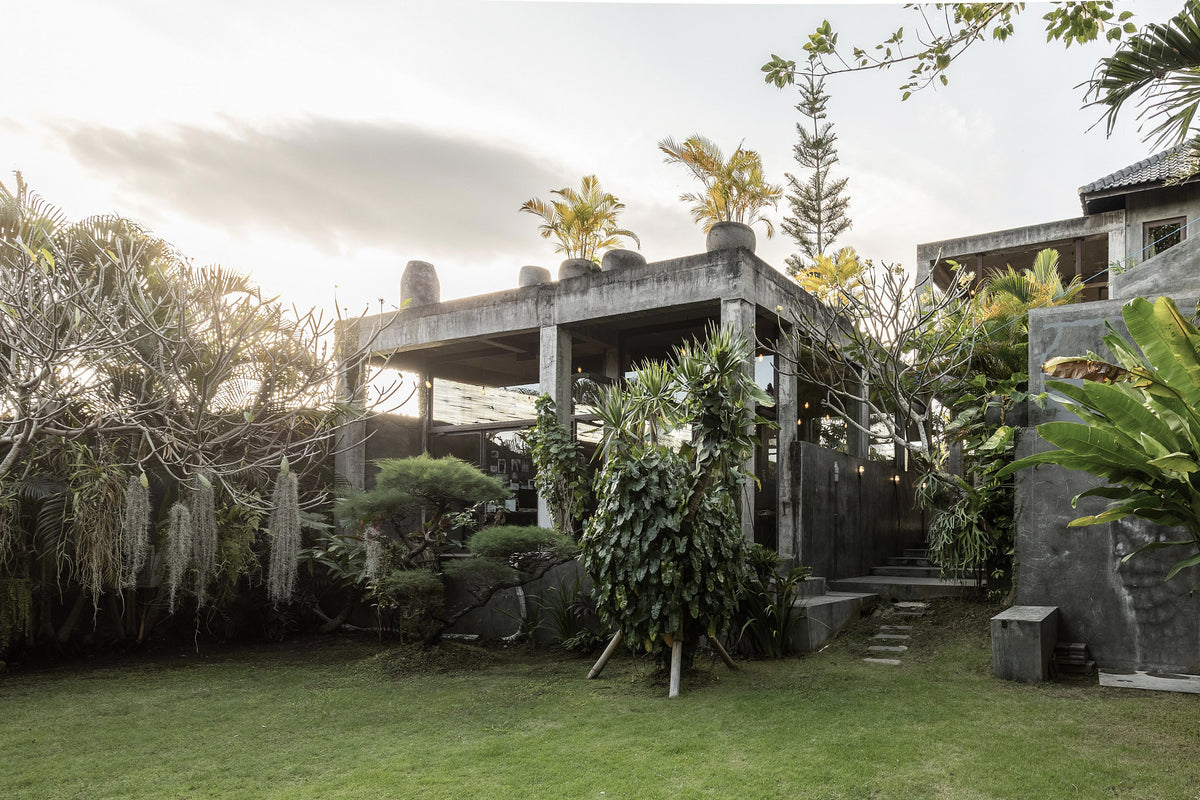
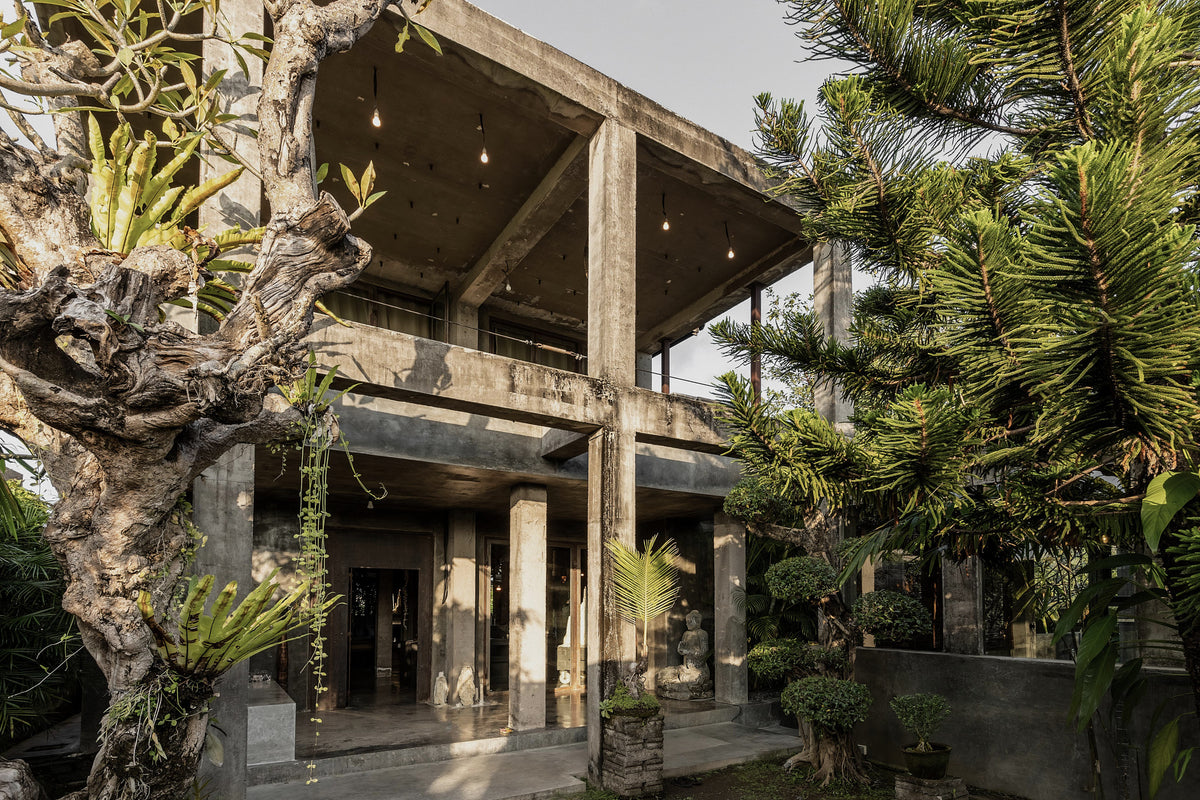
The captions move through the rooms. In the dining room and the living room, left to right, a wedge sofa, a dining table, and a candle tower. On the patio, brass sconces. In the bedroom the bed stands in a niche, and a lamp with citrine hangs on a wooden chain. Then the exterior of the residence, and the exterior of the studio.
The frames show raw concrete, an open ground floor, and a garden of tropical trees.
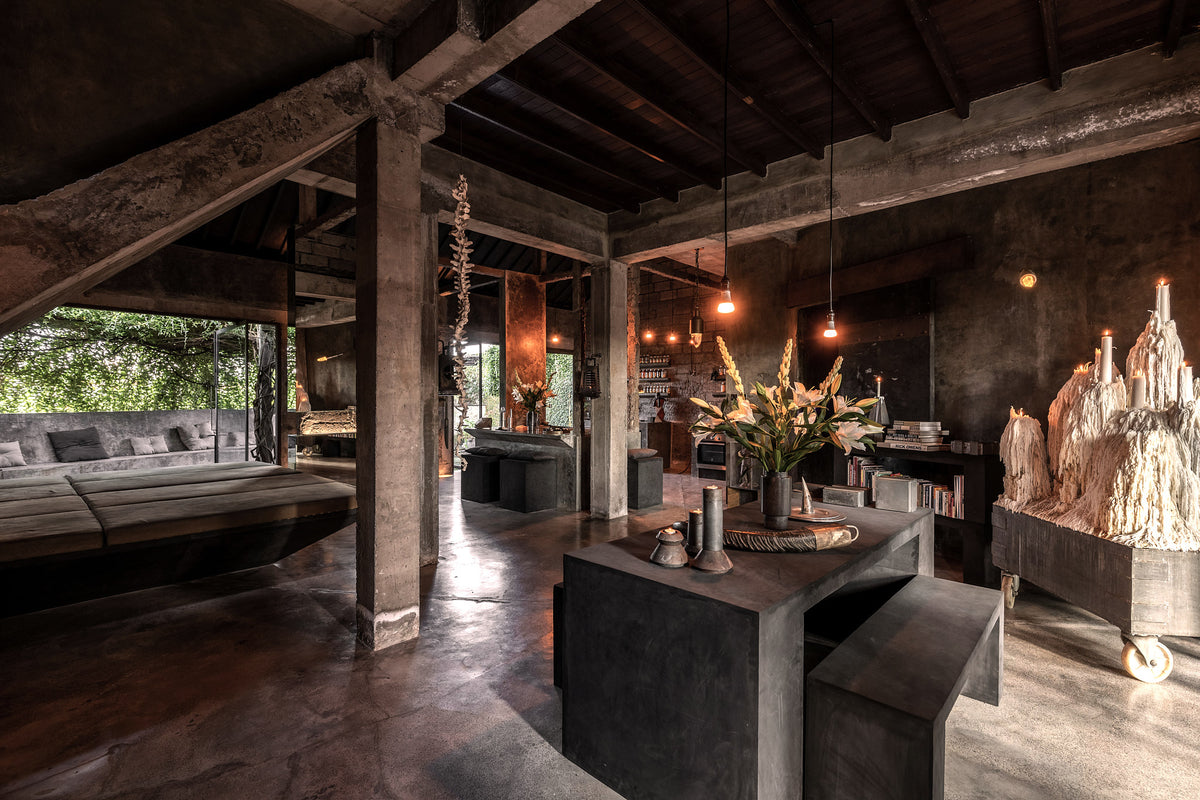
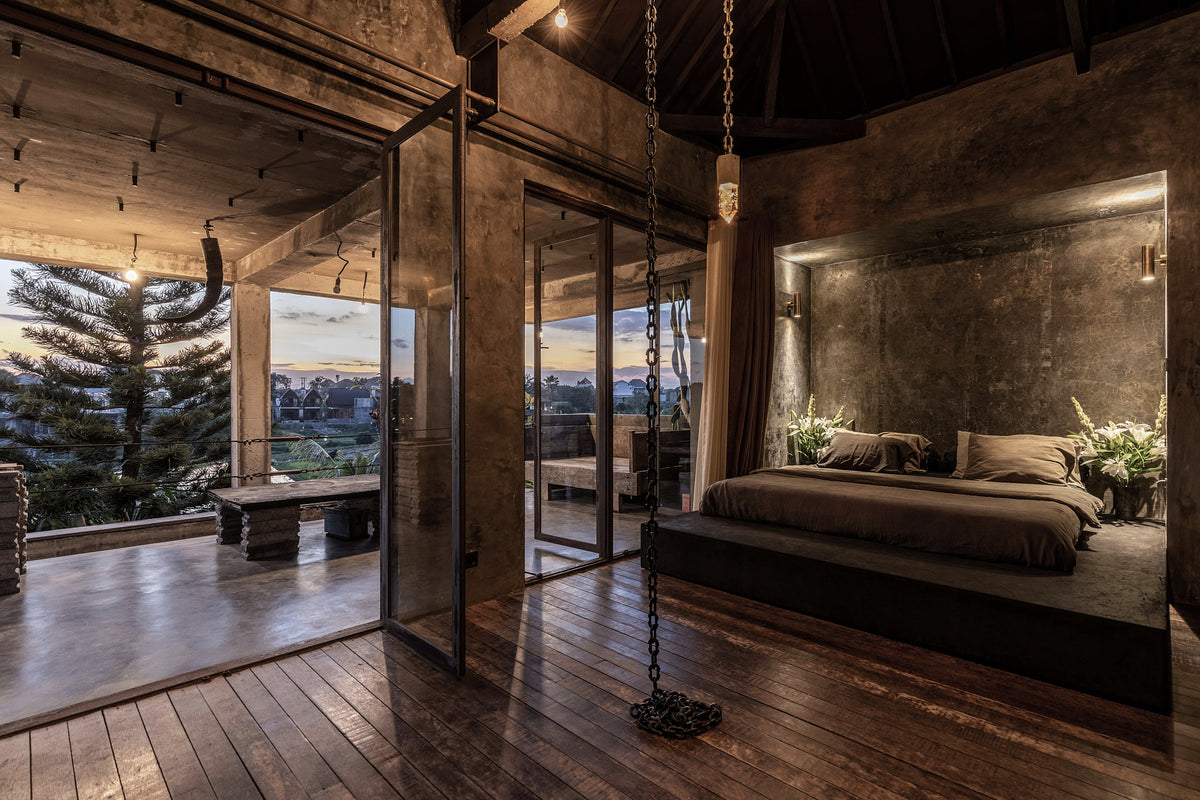
In 2025, slabs of golden resin appear on the same page. The captions are direct. One slab is in Evan’s bathroom. Others are in his bedroom, in the afternoon light.
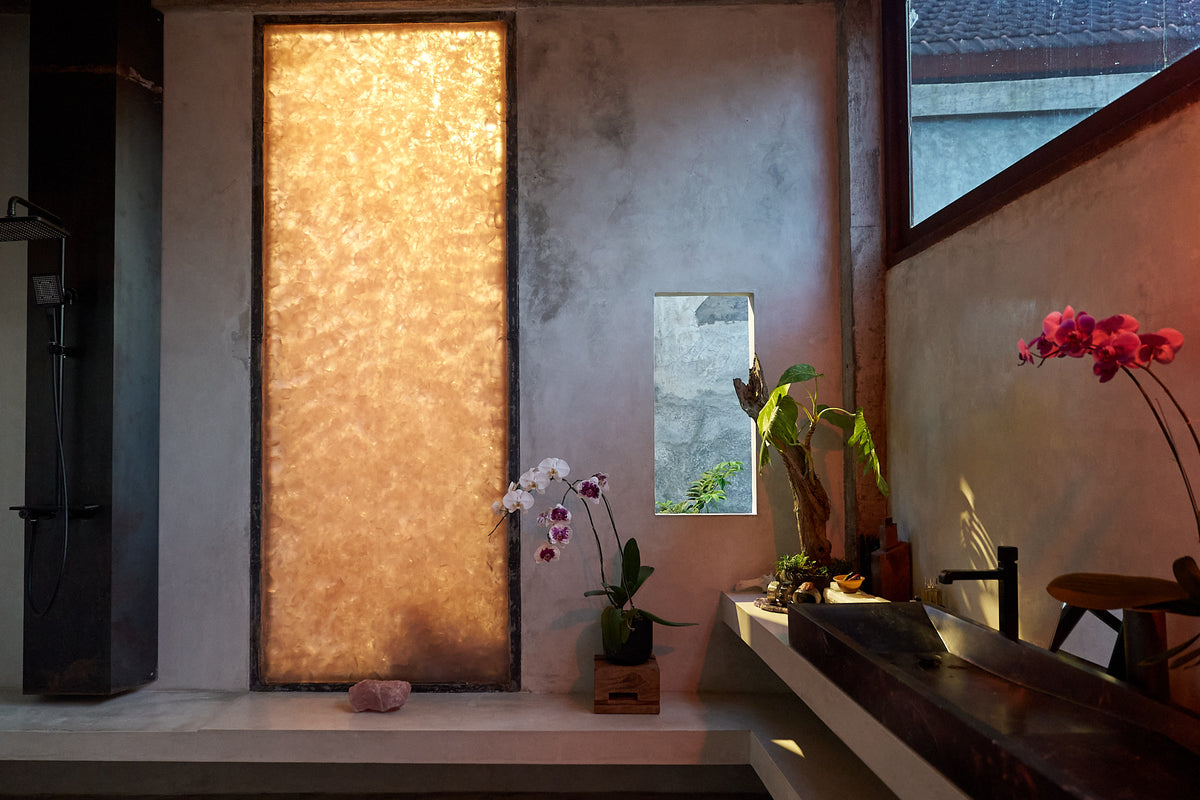
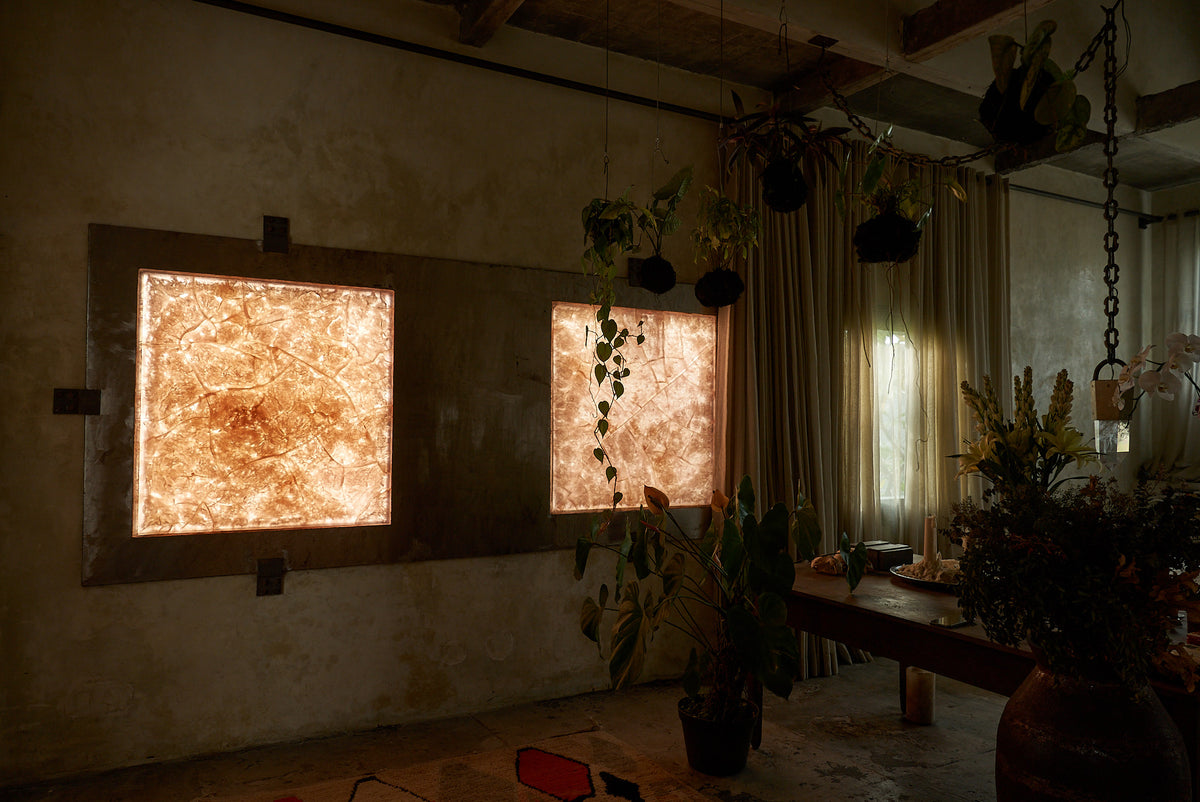
He shows this same residence further on, now in his own frames. On 24 August 2026 the post “PDF excerpt :: The Bunker” is tagged Bali, Indonesia. The open comments praise the space.
The HOME highlight holds this year, from 30 September 2025 to 26 August 2026. In the autumn the concrete is still in progress: a stair, a chain, three people in a raw room, filters, a long table by the windows. On 10 October he captions the polished concrete as a technique from Lombok, based on terrazzo. On 29 October the room holds offerings of fruit, flowers, and incense, and two people in white. The same day he writes about the crew and calls them crazy team. On 6 November several people stand at the bed niche and look at the work.
On 18 December, on a bedroom frame, he writes that the residence is being built and that they already live in it, without a rush. It is a return to Bali: the same land, he says, has been part of the story for twenty-four years. Living in the place that is Parts of Four turned out to be what he needed. For a long time he had tried to get away from it. On 6 August 2026, on a frame with a dog, he calls it our home at P4, just before they left, and the first trial state of the residence. On 26 August the night garden is captioned The Bunny Bunker.
Back in November 2021 that hour-long conversation was coming from here, on a Bali evening. The host could see that the sun had set, and asked him to finish eating. The next day, 25 November, he invited listeners to ask questions on Clubhouse, at nine in the evening his time. The club page today shows the club itself and asks you to download the app. There is no open recording of that evening.
From 2017 the brand feed calls this residence The Sugermans Bunker. That is the caption on the frame of 2 April, on the Christmas greeting of 25 December, and on the post of 19 March 2019. On 28 May 2017 a live video ritual takes place there with Jannah.
Separately, the feed has a furniture line, Parts of Four Home, with Lukas Machnik. On 19 December 2014 the first table leaves, for a shop in Japan. In May 2015 the line is shown at the Collective Design fair, beside Rick Owens pieces. This is a separate furniture line.
The furniture page also has commissions for other people: a dining hall with Sacha Kohn, the Tomb Bench, and the Keiera tables of 2024.
Where is his music?
In 2020 he is asked what comes next. He answers: large installations, and sound will bind the work in a new way.
In that same hour of 2021 the host asks whether he was always in music. Evan goes back to his studies. He put a contact microphone on metal or on a motor. The microphone takes the tremor of the object itself, not a wave in the air. He calls this a long preoccupation.
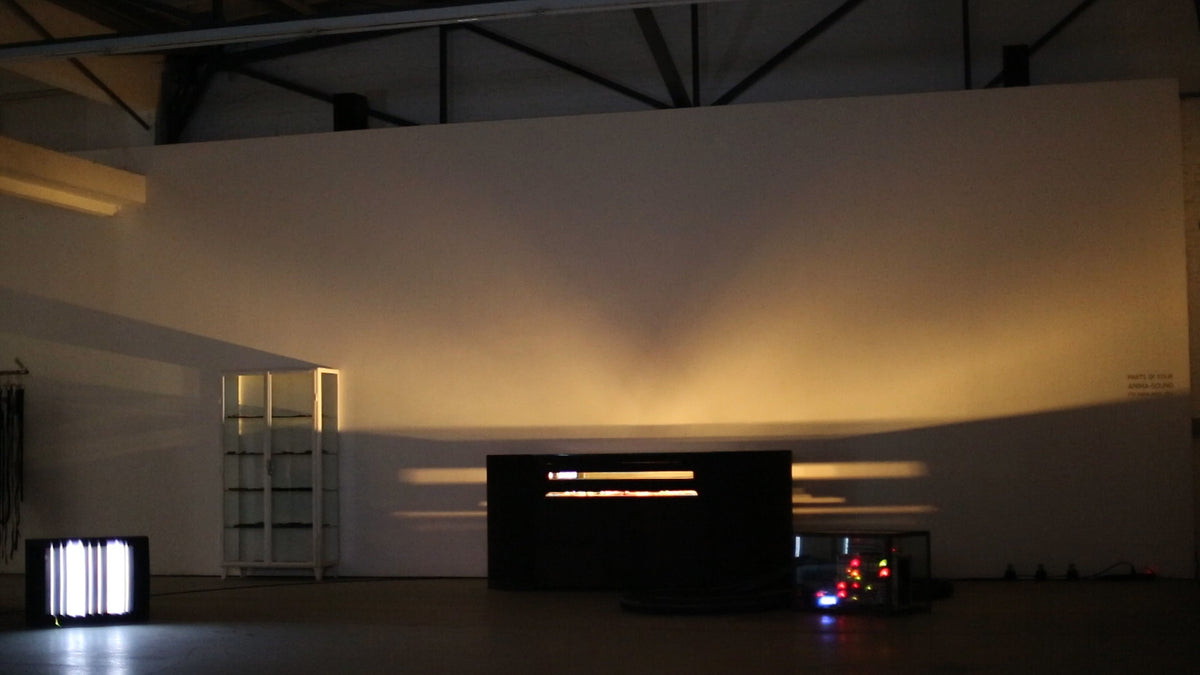
Anima Sound already works this way. On the furniture page the 2014 installation stands in the Berlin shop Darklands. Sensors watch how far a person is. Far away, the installation calls. Close in, it gets scared and answers harder. The body holds subwoofers. The installation journal describes a live modular synthesizer and reprints an article from leparadox.com. The body was made by hand in Bali, from the same dense foam as the packaging. In Berlin the electronic part was added. The address in the journal is Heidestrasse 46–52, building 7.
On 7 May 2021, on Bandcamp, the compilation Dream Interpretation (The Remixes) came out on the label SCI+TEC. The second track of side A is Mother Wading In the River, an EVS remix, 4 minutes 19 seconds. The liner note calls EVS the designer and owner of the Los Angeles brand Parts of Four. On the brand’s site he is also an artist from Los Angeles. The room you can visit stands in Paris.
On 25 June 2024 he posted “Drum Circle — In process.” The frame shows a large membrane on a raw wall and two speaker towers. Threads run to the membrane. This is sound in progress. Nearby are the captions Amplification: Sow the harvest, Nitrical Drone, Generator (A Symphony for Septet), and the earlier Con[verse]tain and Wrapped Speaker. These are neighboring sound works.
What does Instagram show?
The first post of the @partsof4 feed is 16 April 2013: a photograph taken by SOME/THINGS, with thanks to Monika Bielskyte. The early frames after that are Rick Owens pieces made at Black Dove. On 7 November 2026 the feed has 2,584 posts, 393,498 followers, and 95 accounts it follows. The bio is a system of rituals and memory, and then “From the mind of @evansugerman.” Most of the posts are pieces and a link in the header. Among the late ones are a partnership with Robert Eggers’s film Werwulf and with Focus Features, a short jewelry series for Christmas, and a sale from 8 to 15 November 2026.
On 10 April 2025 a video invites people to a soft opening in Bangkok on 18 April, from 19:00 to 21:00. The sound there is Nisatiwa and @notep. The video was shot by @viktorsloth. On 18 April the post calls that same evening an opening party and places a point on the map, Parts of Four Bangkok. On 11 August 2025 the brand shows how it went and thanks @eq_archives for the frames, and @notep and @nisatiwaofficial for the sound.
From 2017, Jannah is the face of the feed. Selections carry her name, fashion-week looks are assembled by her, and the caption says the styling is hers. In November of that year the feed shows a wedding. On 26 April he writes that the wedding rings are in progress. On 28 November he and she have The Sugermans rings, and he writes that he is bound to her by love. On 27 November he calls the ceremony and the shared ritual rave the strongest thing they have made together. On 23 November, wedding bracelets and a Polaroid marked technobride.
On 7 November 2026, @evansugerman has 25 posts. It is a verified account, it/him, creator of @partsof4. Five highlights are pinned at the top: RACER, HOME, LOVESCAPE, SONETICS, FURNITURE. The recent posts, from December 2023 through August 2026, are the residence, furniture, and sound. On 10 June 2024 the post “Parts of Four HQ” is signed together with @partsof4. The comments ask whether there is a room in Bali, and where the building stands. The earlier posts are an archive. On 17 November 2022 he posted an edit by @jannahroy: the Venus party for her birthday, which they threw. He writes that he loves Jannah. In the recording a year earlier, the wife and stylist is named the same way. In the 2020 interview, Jannah wore the Pelican Skull pendant in Paris.
He ran the feed himself in that hour. At first it was a work diary: more of the inside, fewer staged frames. Then for several years he photographed combinations assembled by his wife. Her name is Jannah, and she is a stylist. Followers were not bought. Advertising had run for a long time, and it worked as the back side of Instagram. At first he calls Instagram the only door, then he corrects himself: a door for a time, and the center is the site and the shop, the pieces themselves. The episode title says “fans like Beyoncé.” The announcement text says Kim Kardashian and Beyoncé wore the pieces. In the conversation itself those names are not spoken.
If after this story you want a ring of your own, start with the Thorn ring.
01Who makes Parts of Four?+–
Evan Sugerman, an artist from Los Angeles, together with Damian Yurkievich. The year on the about page is 2011. On the company card it is 2012.
02Where can you see the pieces?+–
In the room at 36 Rue Charlot, Paris. The hours are on the about page: weekdays with a break in the middle of the day, Sunday after lunch.
03Where are the pieces made?+–
In Bali. On the about page that line is the shop Laboutik. The workshops are described by FOB Paris. In the November 2021 conversation he names thirty-one people in the workshop and the office.
04Where does he live?+–
In Bali. In the 2021 conversation he says he had lived there for almost twenty years. On 18 December 2025, in the HOME highlight, he writes that he lives in the residence under construction on that same land, already twenty-four years. On 6 August 2026 he calls it our home at Parts of Four.
05What does he wear himself?+–
In the Vogue Hommes interview he names Chrome Hearts as a preoccupation before his own brand, and on himself Rick Owens and Boris Bidjan Saberi. The profile separately records work on the Rick Owens jewelry line from 2011 to 2015.
06Does he make music?+–
Yes. From his student years it is installations and a contact microphone. In Berlin, Anima Sound works this way. In 2021 his remix under the name EVS came out.
07Are there parties in the public record?+–
In November 2017 the brand feed shows the wedding with Jannah and a shared ritual rave. On 17 November 2022, in the personal Instagram, the Venus party for her birthday. On 18 April 2025, in Bangkok, an opening from 19:00 to 21:00. Drum Circle is a sound work, not a gathering of people.
08Are the pieces split into men’s and women’s?+–
On the about page the jewelry sits outside the season, with no split into men’s and women’s. In the interview he says a man should wear it with confidence and skill, at ease with his own femininity.