Silver 875, 925 or 999 — which grade is best for jewelry
Direct answer: for jewelry worn every day, 925 sterling silver is the best grade — 92.5% silver and 7.5% copper, hard enough to hold its form and recognised as the international standard. 999 silver is purer but too soft for rings or bracelets; 875 is harder and cheaper, but darker in tone and quicker to tarnish. The full comparison below shows when each grade actually makes sense.
"Which silver grade is best" is one of the most common questions from anyone buying their first silver piece. The answer depends on what you mean: best for daily wear, for investment, for sensitive skin, or for a piece that does not tarnish. Each grade has its strengths and weaknesses, and a universal "best silver" does not exist.
In this comparison we break down the three main silver grades that appear on the market in 2026: 875 (the Soviet-era jewelry standard), 925 (international sterling silver), and 999 (technical and investment silver). We compare on 8 parameters: composition, hardness, colour, tarnish, durability, price, applications, and repairability.
Short answer — grade table
875 silver — 87.5% silver + 12.5% copper. The Soviet-era jewelry standard. Harder than 925 but darker in tone and tarnishes faster. Today essentially out of production, found in vintage pieces.
925 silver — 92.5% silver + 7.5% copper (or another alloy). The international jewelry standard. Optimal balance of strength, colour, and workability. The reference for the entire modern jewelry market.
999 silver — 99.9% pure silver. Used for bullion, coins, technical and investment purposes. Too soft for daily-wear jewelry, but barely tarnishes.
If you only need the headline: for jewelry, take 925. For investment, 999. Buy 875 only if you specifically want a vintage piece.
Composition and physical properties
Pure silver is a soft precious metal. In its pure form it is not used in jewelry because it cannot withstand daily load. All jewelry silver is an alloy with additives (other metals introduced for strength).
875 — more copper, darker tone
The 875 alloy carries 12.5% copper — a lot. The high copper share makes the alloy harder (Vickers hardness 90–110 HV against 70–90 for 925) but has three side effects:
- Colour. 875 silver is visibly darker, with a slight yellow cast. 925 sits closer to pure white.
- Tarnish. Copper oxidises faster than silver, and at 12.5% the tarnish appears within weeks of wear. 925 also tarnishes, but 2–3 times more slowly.
- Allergy risk. The more copper, the higher the chance of contact dermatitis on sensitive skin.
In the USSR 875 was the main jewelry grade until the 1990s, and almost all spoons, chains, brooches, and lockets from that period are 875. After the shift to international standards 875 left mass production, but factories still use it for tableware and restoration.
925 — the optimum for jewelry
92.5% silver + 7.5% copper is the historical sterling-silver recipe found by English mints in the twelfth century. The optimum on three parameters: hard enough to wear, white enough in colour, slow enough to tarnish.
The full breakdown of composition, hallmarking, and processing is in our dedicated 925 silver guide.
The main difference from 875: less copper → lighter colour → slower tarnish → lower allergy risk. The main difference from 999: more alloy → higher strength → no deformation under daily wear.
999 — almost pure silver
The 999 alloy is 99.9% pure Ag and 0.1% trace impurities (usually copper or tin remnants that cannot be removed by refining). This is jewelry-grade pure silver, used for technical purposes:
- Investment bullion from 1 g to 1 kg. Price tracks the silver spot market.
- Coins from US Mint, Royal Canadian Mint, Royal Mint, Perth Mint, and other state issuers.
- Technical electrodes for chemical industry and medical equipment.
- Premium audio cables — 999 silver conducts electricity slightly better than 925.
- Telescope mirrors and optics.
999 rarely appears in jewelry. It is used for thin chains, stud earrings, minimalist rings — places where the metal carries minimal load. For a heavy ring or bracelet, 999 will not work: the grade is simply too soft.
Comparison on 8 parameters
1. Strength and hardness
Vickers hardness (HV) is the standard measure of a metal's resistance to deformation. For silver:
- 999 — 25–30 HV (soft as tin, a ring deforms by hand)
- 925 — 70–90 HV annealed, up to 200 HV after cold work (the optimum for daily wear)
- 875 — 90–110 HV (harder than 925, but the difference is not noticeable to a wearer)
Winner: 875 is slightly harder than 925, 999 is markedly softer. But the gap between 875 and 925 is invisible in daily wear — both are strong enough.
2. Colour
In its pure form silver is white with a slight blue cast. The more copper in the alloy, the warmer (yellower) the tone.
- 999 — the whitest, brightest silver shine
- 925 — white, a small warmth from the 7.5% copper
- 875 — a clearly warm tone, sometimes with a touch of yellow
Whiteness winner: 999, then 925. If perfect white is the goal, 999, but durability is worse. 925 is the compromise.
3. Tarnish
Tarnish is silver sulphide — the dark film that forms on the surface from contact with sulphur in air and skin. Tarnish speed tracks copper content.
- 999 — barely tarnishes, holds shine for years
- 925 — tarnishes, but slowly (visible after 3–12 months of wear depending on skin chemistry)
- 875 — tarnishes fast (visible after 2–6 weeks)
Winner: 999. But that does not make 925 a bad choice: 925 tarnish lifts off easily with polishing and does no damage. STRUGA pieces are deliberately oxidised — the darkening becomes part of the design. More on the Living Silver page.
4. Hypoallergenic profile
Silver itself is hypoallergenic. Allergies come from impurities — most often nickel, sometimes cobalt. The more alloy in the mix, the higher the risk (where nickel is present in the alloy).
- 999 — almost 100% hypoallergenic (no alloy)
- 925 nickel-free — hypoallergenic for 95–98% of people
- 875 with nickel traces — can trigger reaction in 5–15% of people
STRUGA uses 925 with copper alloy and no nickel — no reactions reported. More in our hypoallergenic silver guide.
5. Workability
The metal's ability to take shape under casting, forging, engraving, soldering.
- 999 — casts excellently but stamps poorly (too soft, the form "flows")
- 925 — universal: casts, stamps, hammers, solders, engraves
- 875 — casts well but is harder to work (needs more anneal cycles)
Winner: 925. That is exactly why it is the working standard of the jewelry industry: any form is buildable — from the thinnest rings to massive bracelets. STRUGA uses 925 across all methods: investment casting, forging, hand finishing.
6. Price
The silver spot price in early 2026 sits around USD 0.85–0.95 per gram of pure metal. A piece's price tracks the grade (the share of pure silver) and the added value (labour, design, brand).
- 999 — USD 0.85–0.95/g raw, finished pieces USD 18–40/g
- 925 — USD 0.80–0.90/g raw, finished pieces from USD 2.50/g (mass market) to USD 40+/g (author work)
- 875 — USD 0.75–0.85/g raw, vintage pieces USD 6–25/g (depending on condition and rarity)
The raw-material price difference between grades is small. Most of the retail price is the jeweller's labour, not the metal. Buying "purer silver" as a saving strategy does not work.
7. Repairability
All three grades can be repaired: a ring can be re-soldered, sized up or down, an earring post replaced, a broken chain restored. With nuances:
- 925 — the repair standard, every jeweller works it without question.
- 999 — needs care because of softness. Not every workshop will take it.
- 875 — old Soviet-era pieces often solder poorly because of internal-layer oxidation. Restoration costs more.
8. Applications
- 999 — bullion, coins, investment, technical applications, minimalist low-load jewelry.
- 925 — every type of jewelry: rings, earrings, chains, bracelets, pendants, necklaces.
- 875 — vintage jewelry, table silver, restoration.
Which silver grade is best for daily wear
Unambiguously 925. The reasons:
- Sufficient strength — a ring or bracelet lasts decades without deformation.
- Light tone — close to pure silver, no yellowness.
- Moderate tarnish speed — visible only after long wear without cleaning.
- Low allergy risk with the right alloy (no nickel).
- Easy to repair — every workshop works it.
- Backed by every international standard and most national jewelry laws.
999 is too soft for heavy daily-wear pieces. A 999 ring deforms in six months of active wear; a chain with a 999 clasp opens up at the slightest snag. 999 makes sense for thin minimalist pieces worn rarely and gently.
875 is essentially history. New jewelry in this grade is barely produced today, and if you are offered "new 875 silver," it is either restoration or a vintage forgery.
Which silver grade is best for investment
Investment silver is 999, with no alternative. Bullion and coins are issued only in 999 because their price tracks the silver spot. When silver rises, a 999 bar's value rises proportionally. A 925 piece does not work that way: you cannot resell it for "99.9% of the spot of 92.5%" — the jewelry market does not run on that rule.
If you want to invest in silver, buy 999 bullion from a reputable bullion dealer or investment coins (American Eagle, Canadian Maple Leaf, British Britannia, Austrian Philharmonic). Jewelry is a consumer purchase, not an investment.
Which silver grade is best for sensitive skin
For allergic profiles, the best grade is 999 because it carries no alloy to react to. But 999 rarely produces practical jewelry, so the realistic choice is between 925 with no nickel and 925 with nickel.
If you have already had a reaction to a silver piece, ask about the alloy. Brands using copper-only alloys without nickel are safer. STRUGA is one of them. More in our hypoallergenic silver guide.
Which grade STRUGA uses
Every STRUGA piece is 925. No exceptions. Alloy composition: 92.5% silver + 7.5% copper, no nickel. Each piece carries the «925» hallmark plus our workshop mark.
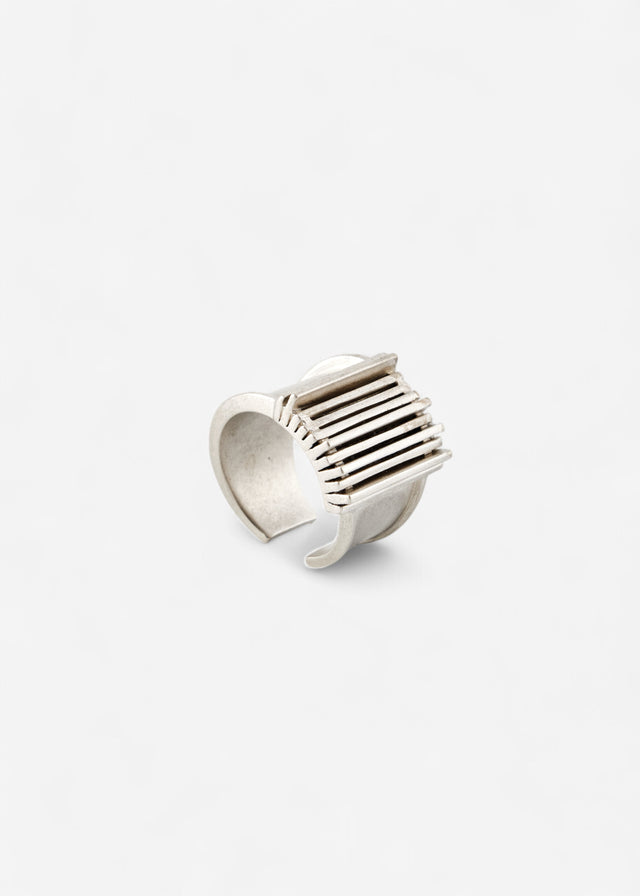
Why we do not make 999 pieces: the grade is too soft for our designs. The Blade family — heavy rings with architectural facets — cannot be built in 999 without losing form. Brutalist ear cuffs, voluminous necklaces, rings with aggressive geometry require sterling at minimum.
Why not 875: today this Soviet-era standard means either restoration or forgery. No serious modern maker designs in 875.
FAQ — which silver grade is best
Which silver grade is most expensive?
By raw-material cost — 999, because it carries more pure silver. By retail jewelry pricing — 925, because that is the grade dominating the mass jewelry market, but premium author work in 925 can exceed standard 999 bullion thanks to labour and design.
Can I wear 999 silver every day?
Not recommended for heavy pieces. A 999 ring or bracelet deforms under everyday loads (closing a door, typing on a keyboard, a firm handshake). A thin chain or stud earrings in 999 are acceptable, but without active wear.
Is 875 still considered silver?
Yes, 875 is full jewelry silver under post-Soviet national standards. In countries running the sterling silver standard (US, EU, UK), 875 does not qualify as a jewelry grade and cannot be marked "sterling."
What is the difference between 925 and 950 silver?
Silver content: 92.5% versus 95%. 950 is an intermediate grade used in Argentium-style germanium alloys and in some French jewelry standards. Outside specific markets it appears rarely.
What is better — 925 silver or white gold?
Different metals with different properties. White gold is gold alloyed with palladium or nickel, plus rhodium plating. Harder and more wear-resistant than silver, but 10–15× the price. 925 silver is the optimum for daily wear on price-to-quality. More in our sterling silver versus other metals piece.
Which silver is better — dark or light?
That is a finishing question, not a grade question. Light silver is polished 925 with no extra treatment. Dark silver is oxidised 925 — the surface is artificially aged in a special bath. The grade is the same; only the surface finish differs. Many STRUGA pieces ship with the signature patina — that is not "different silver," but 925 with a finishing process. More on the Living Silver page.
Summary — which grade to choose
For a piece you will wear daily: 925. No alternative. The world standard, accepted by every jewelry school from Italy to Japan.
For investment in precious metal: 999, as bullion or investment coins, not jewelry.
For a vintage collection or family heirloom: 875, if you already own a specific piece. Buying new 875 makes no sense.
STRUGA works exclusively with 925. Every Blade, earring, ear cuff, necklace is sterling silver with a hallmark. The full guide to our silver is on the sterling silver jewelry guide page. Also: our detailed 925 breakdown and silver engagement ring guide.
If you have a specific question on grade or alloy, write to us directly through the form on the site. We answer ourselves, no sales department.
About STRUGA. STRUGA is a dark silver jewelry brand founded by Dmitry Strugovshchikov and Ekaterina Strugovshchikova, handcrafted with Balinese and international silversmiths. Every piece is 925 sterling silver, naturally oxidized or hand-patinated. The darkening is part of the design. It is a brutalist object that reacts and changes through contact with the environment and the wearer.