John Hardy
John Hardy came to Bali in 1975 and stayed. The jewelry was how he kept from going home. In Mambal stands Kapal, a bamboo building, and its roof curves like a boat. The history page starts in 1975. The large American order, and the year the sale note gives the firm, are 1989. In 2007 he sold his share. The school, the bamboo houses by the Ayung River, and the hotel in Ubud came after that, with Cynthia Hardy.
Updated 9 November 2026.
How did he end up in Bali?
On 29 November 2005 Time describes a lunch under a large banyan at the workshop. More than forty designers, managers and guests sat down. John Hardy stood up and read old report cards his mother had just sent from Canada. Out loud: listless, inattentive, distracted, a daydreamer, tries his best but is too slow. The last sheet is dated 22 June 1967. It says he had not finished what he needed in order to graduate, and that he would have to repeat the twelfth grade. He put the sheets on the table and said he could not have imagined, then, that he would one day read them aloud here in Bali.
Five years later, on 1 April 2010, in a conversation with Kate Bezar for Dumbo Feather, he describes that same departure in his own words. He left Canada because of the weather. He arrived with no craft. He started in business school, then moved to the art school in the same polytechnic, and he did finish that school. The Green Village page names it the Ontario College of Art & Design. He says he was dyslexic, and his school did not have that word yet, so they treated him as unable.
Time places his arrival in the mid-1970s: an art-school degree and a couple of hundred dollars. Going home meant a job in his father’s general store in Ottawa. Every bracelet he sold put that return off a little longer. Later he recognized his own silver in airports. People saw it on each other and, without speaking, knew where the other person had been. The history page dates that arrival to 1975: a Canadian artist gathered a small workshop in Bali.
How did the jewelry begin?
In those first years he worked beside Balinese makers and learned their methods. The history page says that by 1986 the first ten years had gone into silver, into chain weaving, into small metal beads on the surface, and into a pattern cut into the metal. Out of that came the Icon chain. Its page calls the weaving an old Balinese craft he brought back in the 1970s, and dates the chain itself to 1994. One inch, about two and a half centimetres, takes four hours. In 2006 Naga stood beside it. The page links Naga to a Balinese story of a water dragon.
On the silver they put a small mark: the letters JH and the number 925. On the leather bracelet page, that mark on the silver clasp is black enamel.
By then Cynthia Hardy was already beside him. In the Time article she laughs that she did not like him at first: she was dating people on jet skis. In the 2010 conversation he talks about the work. Six people in a kitchen. The two of them kept the books and the orders, and the makers made the jewelry. Without her, he says, he would have stayed a man by the road, full of ideas and with no one to carry them out.
A piece, he says, has to be recognizable. If he cannot tell whose it is, the work is not done. He remembers a woman who bought a bracelet on her birthday and did not take it off for three years. They sold mostly in the United States then. In 1989, Time writes, an order came from Neiman Marcus. The 2007 sale note calls the firm formed in that same 1989, and says John Hardy and Cynthia Hardy started it, eighteen years before the sale. When he was fifty-seven they sold their shares. In that 2010 conversation he says he is turning sixty that year.
What does the place look like?
In 1996 they built the workshop from bamboo, clay brick and thatch, among rice fields, and began sending its water back to the farm beside it. In 1999 John Hardy telephoned Guy Bedarida himself. Bedarida was head designer at Van Cleef & Arpels and had turned the offer down. The next day he agreed to come and look. He moved to Bali. On 5 February 2013, in the Vancouver Sun, he says the pieces are drawn in Bali, and some are made in Bangkok, because Bangkok has a choice of stones that Bali does not. The carving and the weaving, he says, are done by hand in both places. As of August 2012 he calls all the silver in the jewelry metal that has been melted and used again. The materials page now describes silver and gold together: more than 99 percent of that metal has been melted again, and the scraps go into the next pieces. On the history page, in the line for 2000, the firm writes that from the beginning it uses only ethically sourced gemstones and diamonds it calls conflict-free.
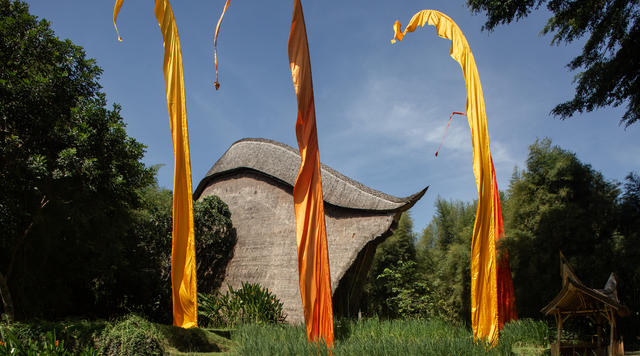
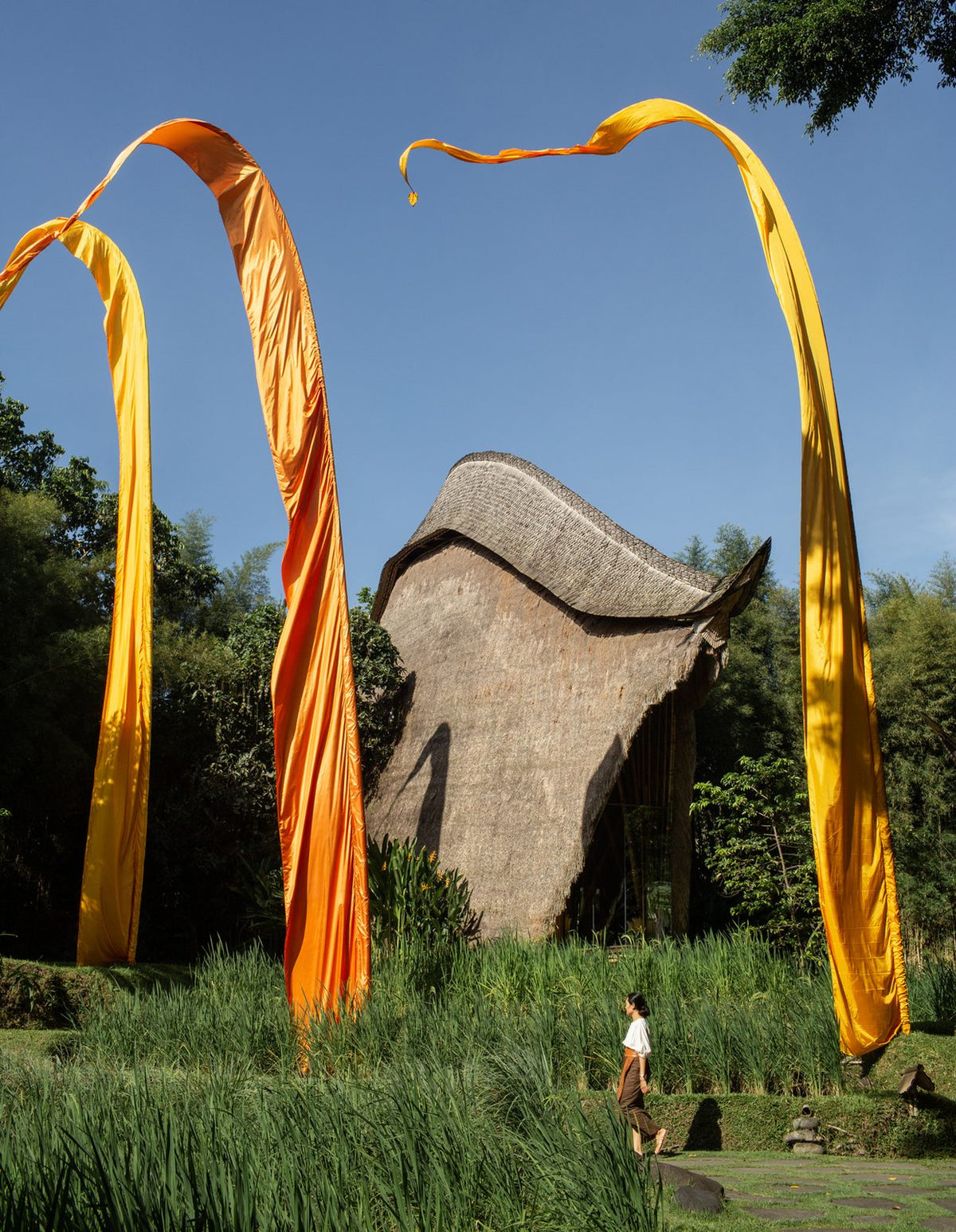
In 2004 the Kapal boutique went up on the same ground. The name is Balinese for boat. The building stands in Mambal, just outside Ubud, at Raya Mambal, Br. Baturning No. 1, Mambalkajanan, Bali 80352. The photograph above is that building: bamboo, and a roof curved like a boat. The boutique is open every day from ten in the morning until six in the evening. The visit page says more than six hundred makers work here. Time in 2005 counts a different day and a different number: more than seven hundred people at the workshop eat a meal grown on the same ground.
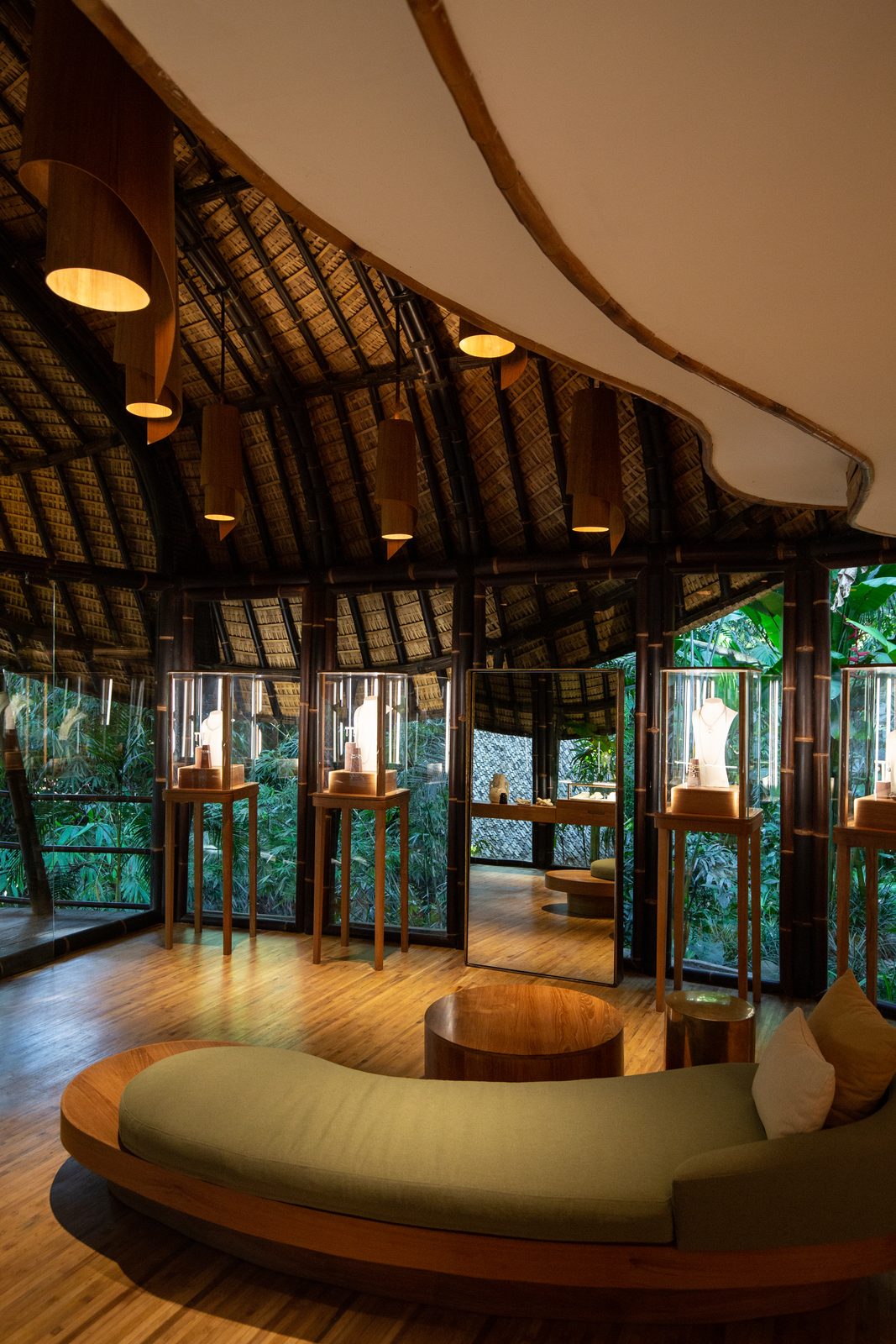
The 2005 article walks through the place. The walls are clay brick, with thorny bougainvillea along the top. The roofs are covered with passion-fruit vines, and people eat the fruit. Lotus ponds sit on the workshop floors. John Hardy says that if the fish die, something is wrong with the water. The hall where the pieces are shown is bamboo, and the Malaysian architect Cheong Yew Kuan designed it. The family house in the same article is a different building. It is made of old hardwood, and among the timbers are ironwood telephone poles. The house seems to hang over a garden. The ground floor has no walls, and the view runs out into the rice fields.
On that same visit they talked about the bombings. It was the third anniversary of bombings that killed 202 people, and eleven days after another bombing. Cynthia Hardy says she first thought of raising money for a hospital, and that they began instead with their own workers: scholarships, midwives for young mothers, care, yoga classes. John Hardy asks what would happen if food across Bali were grown the same way. In 2013 Guy Bedarida names two things that were already in place. For a piece that is sold, they plant bamboo. And there is an apprenticeship for Balinese children from orphanages: they learn the work, so the step out of the orphanage is easier to make. The history page starts the bamboo planting in that same 2007, the year the founders were selling their shares, and later writes that more than a million and a half seedlings were planted.
What remained after he sold his share?
John Hardy and Cynthia Hardy sold their shares in 2007. The sale note names the buyers as the company’s management and the firm 3i Group plc. Damien Dernoncourt is chief executive there, Guy Bedarida is creative director, and the headquarters is given as Hong Kong. On 31 July 2014 the buyer is named Catterton. Damien Dernoncourt keeps a share, now as chairman, without running the company day to day. Robert Hanson becomes chief executive, and Guy Bedarida stays head designer. On 14 September 2022 the majority owner is named L Catterton, and Reed Krakoff is named creative chairman, with a smaller share of his own. The history page places the Spear collection in that same year, Artisan Series in 2024, and the fiftieth year and the JH 50 collections in 2025.
The school grew out of a plain question: where to send his children. He has four. The older two were already in boarding schools, and in that conversation the younger two are nine and thirteen. He walked through schools and heard the same answer: we will give the child an education, and the child will be able to buy a bigger house. That was not enough for him. What stopped him next, he says, was Al Gore. Gore showed what was coming, and the plan to retire and play golf closed. If he can do even a small thing for his children, grandchildren and great-grandchildren, that, he says, is his job. He takes bamboo as the right work for a man who is sixty. If he lives to sixty-seven, he will see a forest he helped plant.
By April 2010 the first students had been in the school for a year and four months. He names one hundred and twenty-five children, and he hopes the school will in time reach four hundred and fifty. A fifth of them are Balinese on scholarship, and altogether the children came from twenty-seven countries. Ronald Stones, known as Pak Ron, ran the teaching. John Hardy made the buildings: from the classrooms to the washrooms they should be beautiful, so a person feels there is something larger than an ordinary day around them. In her introduction Kate Bezar describes a site of more than twenty acres, more than eight hectares, and buildings of bamboo, local grass and clay brick. Cynthia Hardy was in this with him. He says she has the skills he does not. They do not always see the same thing, but more often they come to the same place.
On the Green School page they are named co-founders, and their line is there: the school is a model they built for the world. That page places the beginning in Bali, and then names schools in New Zealand and South Africa. In May 2021 it also writes about a partnership with Education in Motion, a group of schools. The houses stand nearby, at another address, Green Village. The village page says John Hardy imagined it and first developed it while he and Cynthia Hardy were building the school. On the slopes by the Ayung River there are twelve bamboo houses and villas. The IBUKU team, which builds in bamboo, put them up, and Elora Hardy leads that team. She is the daughter of John Hardy, the co-founder of Green School. The page does not say which of these houses he himself lives in.
The hotel is called Bambu Indah, in Ubud. John Hardy and Cynthia Hardy sign the page. There are twenty-four houses: bamboo, copper, teak brought from Java, a nest in the branches of a large tree. Some rooms have no walls. The page says the cooling is only in the beds. Guests can harvest the rice with them. In the 2010 conversation he is simply in Bali, looking at the rice fields every day.
Where can you go, and what is on the account?
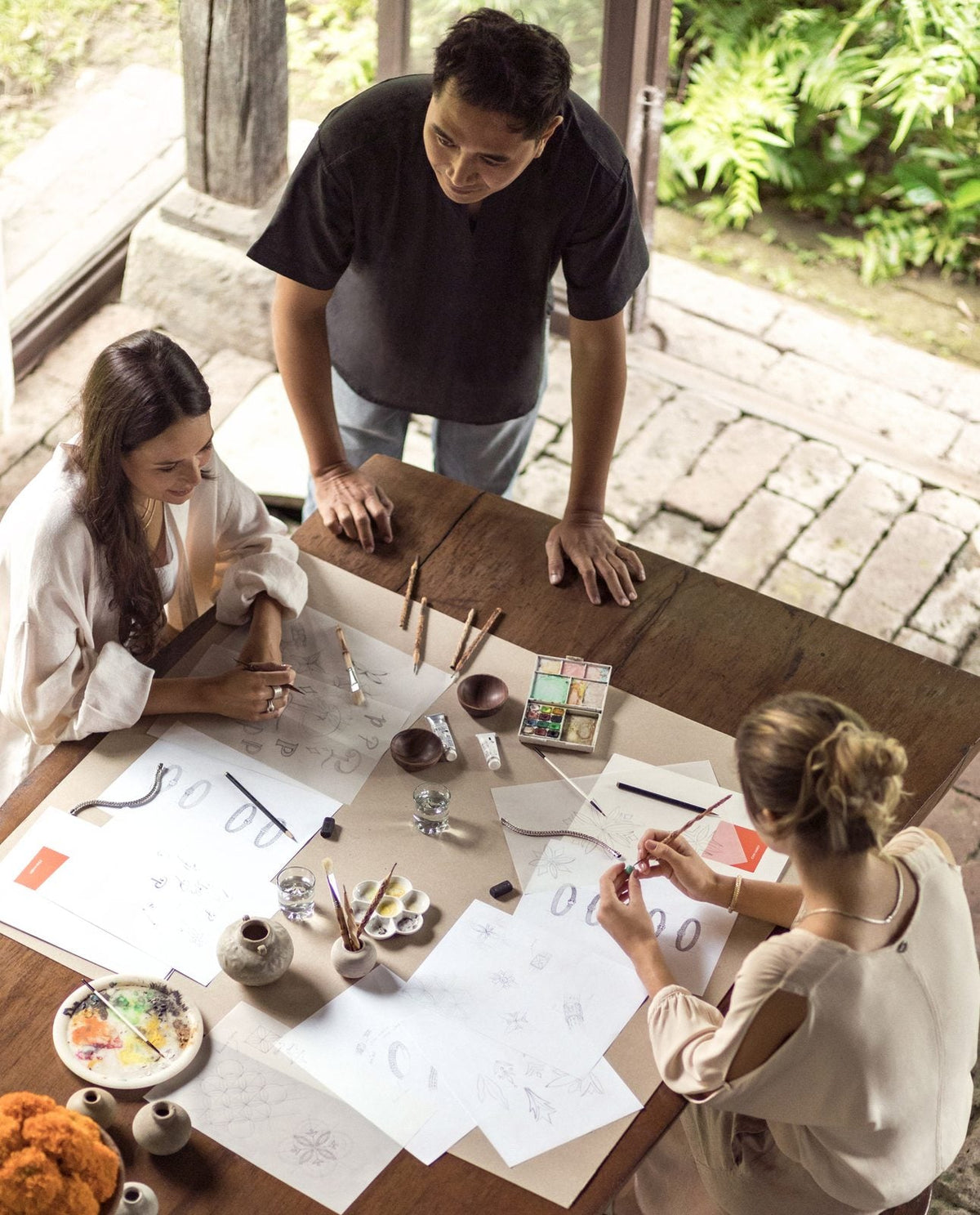
At Kapal, on weekdays from ten until four, you can walk the workshop, and from ten until two you can sit down to a class if you reserve two days ahead. The class goes from a watercolour and wax to weaving and finishing. You can order your own piece, and it is sent in eight to twelve weeks. The same day they show the archive and sit you down to a shared lunch. An Icon bracelet with initials is woven at the Seminyak boutique, every day from eleven until two, again with two days’ notice. That boutique stays open until nine in the evening. In Jimbaran, at the AYANA resort, the boutique is open from noon until nine, and the Icon, Naga, Spear and Love Knot chains are there. At Kapal the address is kapal@johnhardy.com, or WhatsApp +62 811 3852 233. The visit page has its own number, +62 811 3800 3300, and Seminyak and Jimbaran use it too. That page also lists a five-night trip run by Skylark Agency. The trip is described in Skylark’s note on the five nights.
I opened the account johnhardyjewelry on 9 November 2026. On the page that shows without an account, the name is John Hardy, there are 181 thousand followers, eight accounts followed, and the line Artisan Crafted for Over 50 Years. The saved stories are titled AS SEEN ON, GET INSPIRED, IN THE NEWS, BILLIE EILISH, FINNEAS, LOVESTRUCK and AC x JH. The grid shows recent jewelry: woven chains and a necklace. A post or a story opens only after a sign-in, so the first post cannot be read from here. His early years are written down in the 2010 conversation and in the 2005 Time article. The firm that carries his name keeps this account.
The journal you are reading is STRUGA. For the international market, STRUGA objects are made in Bali.
01Who is John Hardy?+–
A Canadian artist who came to Bali in 1975 and began making jewelry with local makers and with Cynthia Hardy. The history page starts in 1975. The 2007 sale note names 1989 as the year of the firm. Films and an actor with a similar name turn up in the same search. This page is about the jewelry, and about the man who lives in Bali.
02Where does the main Bali store stand?+–
Kapal in Mambal, just outside Ubud: Raya Mambal, Br. Baturning No. 1, Mambalkajanan, Bali 80352. The boutique is open every day from ten in the morning until six in the evening. The photograph above is that bamboo building with the boat roof. The address and the hours are on the Kapal page.
03Where are the pieces made?+–
They are drawn in Bali. In February 2013 Guy Bedarida said that some pieces are made in Bangkok, because Bangkok has a choice of stones that Bali does not. He called the weaving and the carving handwork in both places.
04Who owns the firm?+–
In 2007 the founders’ share was bought by the management and by 3i Group plc. In 2014 the buyer is named Catterton. The note of 14 September 2022 names L Catterton as the majority owner, and Reed Krakoff from that day as creative chairman, with a smaller share of his own.
05What did he do after selling his share?+–
With Cynthia Hardy he made the Green School. While they were building the school, he began Green Village: twelve bamboo houses and villas by the Ayung River. The IBUKU team put them up, and his daughter Elora Hardy leads that team. They also sign the Bambu Indah hotel in Ubud with their own names.
06How do you join a class?+–
Reserve through the Bali visit page, two days ahead. At Kapal the class is on weekdays from ten until two. An Icon bracelet with initials is woven in Seminyak from eleven until two. An ordered piece is sent in eight to twelve weeks. The visit page number is +62 811 3800 3300. Kapal’s WhatsApp is +62 811 3852 233.
07Where does he live?+–
In the conversation of 1 April 2010 he is in Bali, looking at the rice fields every day. In 2005 Time describes a family house of old wood over a garden, with no walls on the ground floor. The houses he imagined for other people stand at Green Village by the Ayung River. The village page does not say which of the twelve houses he himself lives in.
08Where can you buy a piece?+–
On the firm’s site and in three places in Bali: Kapal in Mambal, the boutique in Seminyak, and the boutique at the AYANA resort in Jimbaran. The pages read for this article do not name a Moscow address.