Meteorite Jewelry: How to Choose, Wear and Care for It
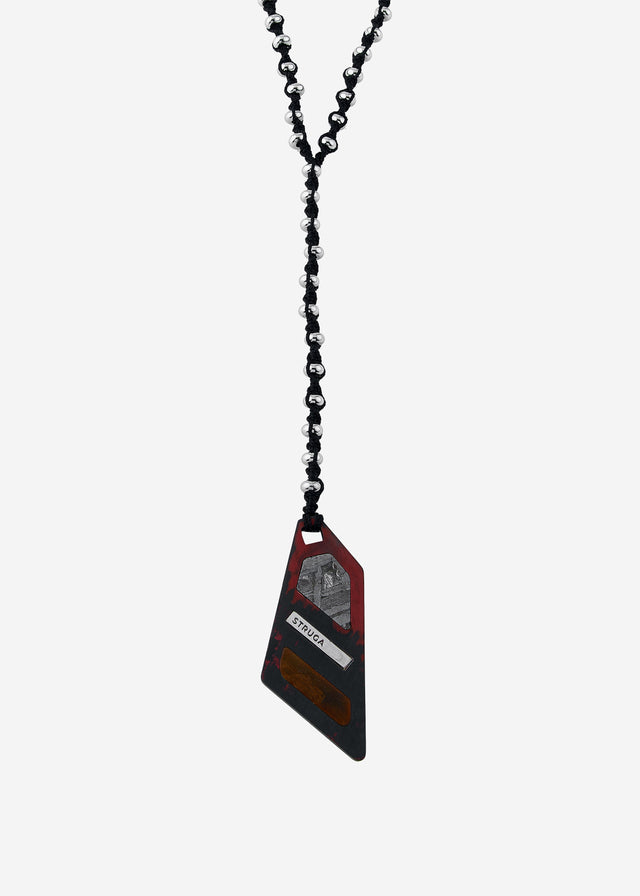
Meteorite jewelry contains a fragment of extraterrestrial material. In a metallic Seymchan insert, cutting and etching can reveal the crystal pattern inside the metal. Set beside silver, it remains a separate material with its own structure and care needs.
Choose meteorite jewelry by its named material, the appearance of the cut surface and the construction of the whole piece. Magnetism offers a clue, not proof of origin. Dry wear and storage matter. STRUGA's two Seymchan catalogue designs belong to the archive; a new meteorite object starts with an individual commission.
Updated October 24, 2026
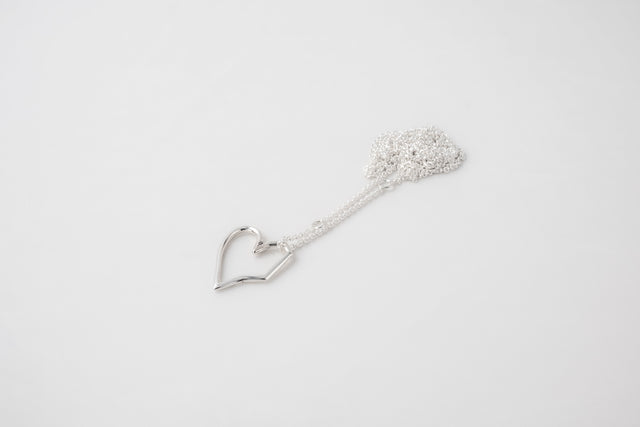
For an object that explores carbon and metal in the current catalogue, see Fused Mini Line Bloody. It has no meteorite insert: it brings different materials together in a different way. These STRUGA pendants connect the MOSAIC family with the RITUAL world.
The pattern runs through the metal
The intersecting bands visible on an etched metallic Seymchan slice are known as a Widmanstätten pattern. They reveal a three-dimensional crystal structure, so changing the direction of the cut changes the pattern you see. The American Museum of Natural History describes its formation during the slow cooling of metal inside ancient planetary bodies. The crystals grew over millions of years. See the museum's explanation of the structure.
Cutting exposes a plane; polishing levels it; etching reveals the crystal boundaries. The visible result therefore depends on both the material and its surface treatment. Polishing can soften the appearance of the pattern while leaving the underlying material in place. In a finished object, that is a reason for careful maintenance rather than an invitation to try etching at home.
STRUGA uses Seymchan. Van Niekerk and colleagues classified it as a main-group pallasite in their 2007 study, describing both olivine-bearing areas and large metal regions without olivine. A small insert need not show green crystals to come from this material. The separate guide to Seymchan meteorite follows its history and structure; this article looks at what happens when a fragment becomes something to wear.
Seymchan and other names
Seymchan, Muonionalusta, Gibeon and Campo del Cielo identify different meteorites. Arizona State University's collection catalogue lists them as follows:
| Meteorite | Type | Catalogue group |
|---|---|---|
| Seymchan | Pallasite: metal and olivine | PMG |
| Muonionalusta | Iron | IVA |
| Gibeon | Iron | IVA |
| Campo del Cielo | Iron | IAB-MG |
The letters identify scientific groups, not grades of jewelry quality. The table keeps the names distinct; the appearance of a particular insert still needs a closer look because cutting direction and surface treatment affect what you see. See the four entries in ASU's collection catalogue, PDF.
What to look at before buying
First establish what sits inside the setting: a continuous slice, separate fragments or an image. That distinction affects both appearance and care. A patterned metal plate and small particles held in another material are different constructions, even when both contain meteorite.
| What to examine | What it helps explain | Its limit |
|---|---|---|
| The named meteorite | Which material the insert is described as, such as Seymchan | “Cosmic” alone gives little material information |
| The slice under magnification | How the bands and surface treatment appear | A photograph of a similar pattern does not identify its origin |
| Attraction to a magnet | How the metallic portion responds | Terrestrial materials can also be magnetic |
| The insert's weight and dimensions | How dense the material feels for its size | The weight of a whole necklace includes its setting and cord |
The North Carolina Museum of Natural Sciences treats magnetism as one clue among several: terrestrial minerals and metal slags may also attract a magnet. The University of Arizona makes a similar distinction about density. These observations describe physical properties shared with some terrestrial materials. Their combination is not a reliable home test of extraterrestrial origin. Examine the finished object without scratching or etching it. The museum's meteorite FAQ and Arizona's guide to physical characteristics explain the limits of these checks.
How to wear meteorite jewelry, and what skin contact means
On a pendant, the visible face of the insert lets you follow the bands in the meteorite, the edge of the setting and the transition to carbon. You can follow a similar meeting of carbon and metal in Asymmetric Bloody, a current design without meteorite. Plain fabric makes these changes easier to see than a densely patterned shirt. Choose a cord length that lets the object sit freely without catching the edge of a neckline.
There are two different safety questions. An extraterrestrial origin does not mean dangerous radiation: the University of Arizona's Lunar and Planetary Laboratory explains that meteorites do not emit it. Skin contact with a finished piece is a separate matter. Its materials, edge finishing and the wearer's individual response all matter; the origin of the insert is no universal assurance of tolerance.
If an itchy rash develops beneath a piece, stop wearing it. This follows the American Academy of Dermatology's advice for a reaction beneath jewelry; a dermatologist can investigate a recurring reaction. Wearing a pendant over clothing also lets you position the object without keeping its insert against bare skin. Read the dermatologists' guidance.
How to care for meteorite jewelry so it does not rust
Keep a metallic meteorite insert dry. Moisture and salts accelerate corrosion in iron-bearing materials. The Canadian Conservation Institute's guidance on metal storage starts with controlling dampness and contamination. For a small worn object, the practical difference begins with where it rests: a closed, dry box is a better home than a bathroom shelf.
| Situation | Action |
|---|---|
| Showering, swimming or exercising | Remove the object beforehand and put it somewhere dry |
| After ordinary wear | Gently wipe it with a soft, dry cloth |
| Storage | Put the completely dry piece away separately; use dry silica gel in a closed box |
| Orange spots or loose corrosion | Stop home cleaning and contact STRUGA with a photograph |
Care for the assembled object, not just one of its materials. Immersing a mixed-material piece in silver cleaner or rubbing it with an abrasive also affects its neighbours. A dry cloth is the starting point for everyday care. Oil, wax or surface restoration needs to suit the particular piece; a treatment for a loose museum specimen cannot simply be transferred to a finished necklace.
Protection needs attention too. GIA documented meteorite specimens with corrosion at their edges despite a plated surface. That example explains why a coating does not replace dry storage. STRUGA offers free lifetime cleaning and minor repairs: if the surface changes, begin by contacting STRUGA with a photograph. The sterling silver care guide covers the silver component separately; the meteorite needs its own approach.
How much does meteorite jewelry cost, and what are you paying for?
STRUGA's catalogue contains two designs tagged with meteorite: Asymmetric Fused Bloody with Meteorite and Asymmetric Fused Winter with Meteorite. Both belong to the archive. Their former price is not a quote for a new commission, and a surviving product page does not mean that the design is currently on sale.
A new object's cost depends on its form, the quantity of material, the setting, the fitting of the insert and the surface work. Compare like constructions: the price of a small fragment and the price of a finished pendant answer different questions. For an individual commission, send the intended shape, dimensions and a reference showing how you want to wear it. STRUGA can price a specific object after discussing its sketch; the current catalogue does not set a fixed price for a meteorite design.
Meteorite rings
A meteorite ring can combine a band with a separate meteorite insert; its name need not mean that the entire ring is cut from meteorite. At STRUGA, meteorite is a possible insert for DARK UNION. The material, form and price are discussed for the particular pair through an individual commission.
Is it legal to own meteorite jewelry?
In the UK, buying a finished meteorite piece follows the ordinary rules for goods: the seller must have the right to sell or transfer it when ownership passes to the buyer. Section 17 of the Consumer Rights Act 2015 sets out that protection. It is the lawful transfer of the object that matters, rather than a claim that anything from space is free to take. Read the official provision on the seller's right to supply goods.
Finding a meteorite yourself is a different situation. On permitted US Bureau of Land Management land, casual collecting is for personal use; that material may not be sold or bartered, and commercial collection requires a separate permit. Owning a purchased pendant gives no right to collect on someone else's land. Before collecting or moving a raw specimen across a border, check the rules for that territory. Read BLM's official collecting policy.
Meteorite at STRUGA: material within a form
At STRUGA, Seymchan belongs to the language of combined materials: pendants, MOSAIC inserts and a possible insert for DARK UNION. Its geological origin gives the object a specific history; the setting determines how someone sees and wears it. Any personal symbolism belongs to the wearer, rather than to a promised power of the material.
For the international market, STRUGA objects are made in Bali. A visitor interested in a meteorite commission can start the conversation before travelling, allowing time for the form and material to be discussed. The where-to-buy page lists the current places to see STRUGA on the island; an archived meteorite design should not be assumed to be available there.
The current catalogue offers other ways to examine the meeting of materials. Asymmetric Bloody pairs carbon and metal in an asymmetric outline. Cross Bloody Graphite takes that contrast into a different form. Signature Asymmetric Aged offers another asymmetric composition of materials. These current objects do not contain meteorite.
The crystal structure already existed inside the meteorite. Cutting and etching reveal it; the setting turns the slice into an object that can be worn.
Sources and further reading
Frequently asked questions
Didn’t find the answer — write to us, we reply personally.
Ask a question →01Is meteorite jewelry the same as space-themed jewelry?+–
A meteorite piece contains a physical fragment of extraterrestrial material. A space image in resin, enamel or print can depict the same subject without containing meteorite. Look for a description of what sits in the setting: a slice, separate fragments or an image.
02How does meteorite differ from darkened silver?+–
Meteorite describes the insert's material; darkening describes the surface of the silver component. The two can sit together, but caring for the setting does not replace care for the insert. Do not treat an entire mixed-material object with silver cleaner without considering its other materials.
03How can I tell whether a meteorite insert is real?+–
Compare the named meteorite, the appearance of its cut surface and the metallic portion's magnetic response. Terrestrial materials can share these properties: combining these observations is not a reliable home test of extraterrestrial origin. Do not scratch or acid-etch a finished piece as a home test.
04Is Seymchan the same as Muonionalusta?+–
They are different meteorites. Seymchan is a main-group pallasite; Muonionalusta is an IVA iron meteorite. A small Seymchan slice can consist of metal without visible olivine. Colour in a photograph is not enough to identify a finished insert.
05How can I recognise rust on a meteorite insert?+–
Orange spots or loose corrosion deserve attention. A surface can darken for different reasons. Remove the object, keep it dry and send STRUGA a photograph. Abrasive cleaning before a suitable treatment is chosen can change the visible pattern.
06Where can I buy Seymchan jewelry from STRUGA?+–
STRUGA's two meteorite designs belong to the archive. For a new object, use the individual commission form and send the shape, dimensions and intended material. The current necklaces linked above do not contain meteorite.
07Are meteorite pendants suitable for men?+–
STRUGA's two archived meteorite designs are tagged unisex in the catalogue. Choose by shape, cord length, weight and how the object sits on clothing.