
Silver Signet Ring for Men: STRUGA Architectural Guide
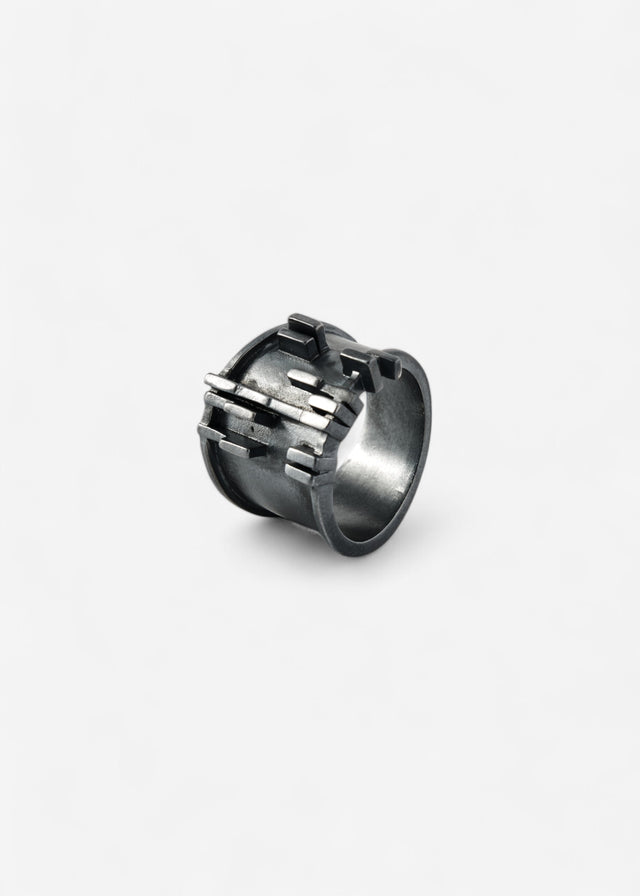
Key takeaways
- A signet ring is a heavy 925 silver ring with a solid top plate, descended from medieval seals.
- Worn today as a statement of weight and presence — not for sealing wax.
- STRUGA brutalist signets keep raw casting marks: hammered top plate, no polish.
- Sizing: pinky 8–10 US, ring or middle finger 9–12 US; weight 22–35 g.
- Pairs with minimalist outfits — one bold ring per hand reads as intentional, not loud.
- Oxidized finish deepens with wear; that is by design, not a defect to clean.
- Living Silver care: dry storage, soft cloth wipe, polish only the high points if desired.
A silver signet ring is a massive men's ring with a solid top plate, the descendant of medieval signet rings used to seal letters and contracts in wax. Today the signet is worn not as a cipher but as a statement: weight on the finger, dense volume, straight lines. STRUGA reinterprets the signet through the architectural brutalism design code — architectural silver without decorative engraving or heraldry. This is wearable sculpture, not period stylization.
Related reading: Norse rune silver jewelry guide, amulet jewelry meaning guide, Byzantine silver chain guide, silver patina — Living Silver, STRUGA full catalogue.
TL;DR
- A signet ring is a men's ring with a solid top plate, originally a functional object (a wax seal), today an artifact of identity.
- Weight categories: 10–15 g — light, 15–22 g — medium, 22–30 g — heavy, 30 g+ — massive statement. STRUGA Brutalism V.1 and V.3 run from 10 to 24 g depending on size.
- The classical signet has an oval or shield-shaped plate ready for engraving. The brutalist signet has an architectural plane and sculptural volume, without heraldry.
- The Brutalism V.1, V.2, V.3 design code was developed in collaboration with an architect; V.1, V.3, and future V's are parallel variations of one language, not evolutionary steps.
- STRUGA does not rhodium-plate silver: the signet darkens with age and gathers patina — part of the Living Silver concept.
What a signet ring is and where it came from
A signet ring is a men's ring with a flat or slightly convex top plate, wider than the shank (the lower part that wraps the finger). The plate can be oval, square, rectangular, octagonal, or shapeless — its form is not predetermined. The defining feature of the signet is the mass on top, which reads as a separate object rather than as a smoothly flowing band of metal.
The English word "signet" comes from the Latin signum and refers literally to a "small seal": on the top plate of the ring a mirror image of a coat of arms, monogram, or personal mark was carved, and the ring itself was used to imprint it onto hot sealing wax. A seal on a letter meant that the sender was actually who they claimed to be. Before mass literacy and printing, this was one of the few ways to verify the authenticity of a document.
The signet as a functional object existed long before medieval Europe. The earliest finds date back to ancient Sumer and ancient Egypt: officials wore cylindrical or scarab-shaped seals on their fingers, rolling impressions onto wet clay. Ancient Rome turned the tradition into an everyday standard: every free citizen of middling means had their own signet, and Suetonius writes that Caesar and Augustus wore signet rings with personal marks (Caesar's was an image of Venus; Augustus's was first a sphinx, then the profile of Alexander the Great).
In Byzantium and medieval Russia, the signet became a marker of social class — worn by princes, boyars, and clerks. Heraldry of the European kind took root late in Russia (17th–18th centuries), and before that signets carried names, initials, and saints' marks. After the reforms of Peter I, family coats of arms appeared among the nobility, and signet rings became almost an obligatory element of male dress — alongside the cane, watch, and snuffbox.
In the 20th century the signet went through several waves. In the 1920s and 1930s European and American elites wore it as a quiet status marker. In the 1970s, the rock and rap scenes reinterpreted it as a symbol of strength and independence from class codes: heavy silver rings on bikers and in gangsta aesthetics carried not a coat of arms but a skull, a heart, a cross, an abstract volume. In the 1990s, mass jewelry producers turned the signet into an everyday male accessory — a smooth oval plate, base silver, sometimes with initials.
In the 2020s the inversion ran the other way. The signet was taken back by the auteur segment — brutalist, architectural, minimalist. Today it reads not as a symbol of origin but as a statement of one's own form. Not "I am from such-and-such a line," but "I chose this volume."
Why a man wears a signet in 2026: artifact of identity, not costume
The signet differs from an ordinary ring in one detail: it has a face. A narrow wedding band is uniform around the circumference — it has no top and no bottom. The signet has a clearly expressed top plane, always facing up (or toward the other person at a handshake). This geometry makes the signet the first piece of jewelry noticed on a hand. It does not blend with the finger — it reads as a separate object.
Because of that visibility, the signet is the most concentrated male statement of all jewelry categories. A chain is hidden under a shirt, a bracelet flashes from under a cuff, a thin ring blends with the back of the hand. The signet stands on the finger like a small stele. So the requirements for it are different. It has to be a complete design object, not a "neutral" plate. If the form is incidental or flatly imitative, the signet reads cheap — even if the silver is heavy and the hallmark is right.
In 2026 men's fashion has moved away from noisy accessories toward quiet status: one or two pieces that work as a signature. The signet fits this logic precisely. It demands a choice — what form, what weight, what finish. That choice communicates more than any monogram. A smooth oval classic says one thing; a dense architectural plane says another; brutalist asymmetry says a third. The signet does not carry a message — it is the message, in its pure form, without decoding.
It is worth drawing the line right away. A signet as an artifact of identity is not an accessory for a friend's wedding suit. It is a thing a person picks once and wears for years, and it integrates into their everyday image — with a jacket, a shirt, in the office, at home, in the gym. The more often it is taken on and off, the less sense the purchase makes. The signet works only as a daily object.
Sizes and weight categories: how a signet feels on the finger
The weight of the signet is the main technical parameter after form. Weight determines visual scale, tactile feel, and how the ring behaves through the day. Silver is heavier than it looks (density 10.49 g/cm³), and the difference between 10 g and 25 g on the finger is as palpable as the difference between an ordinary watch and a large chronograph on the wrist.
10–15 g — light category. Plate is thin (3–4 mm thick), shank is narrow. The ring registers as presence but does not dominate. Suits those wearing a massive ring for the first time, or people with thin fingers and narrow hands. Brutalism V.1 in sizes 16–17 falls into this category (10–11.5 g). The finger gets used to it within a day; you do not need to take it off at night.
15–22 g — medium category. This is the "right" signet weight for most men of medium and large build. Plate is dense (5–6 mm thick), the ring is felt on the finger constantly but does not interfere with hand work. Brutalism V.3 and V.1 in sizes 18–21 (14–22 g) — the main range for the medium category. This is the weight at which the signet reads as a complete artifact, not as a light accessory.
22–30 g — heavy category. Serious mass. The finger feels the ring continuously; hand muscles tire by the end of the day if not used to it. Suits large men, those deliberately seeking "weight as a statement," and those who wear a signet only in certain situations (not every day). Brutalism V.1 and V.3 in size 22 (24 g) — at the upper boundary of this category.
30 g+ — massive statement category. No longer an everyday signet, more an object for special occasions. Silver in this volume reads as a small sculpture. STRUGA's standard Brutalism size grid does not reach 30 g+, but through the Custom Order service such a modification is possible — enlarged plate, expanded shank, additional volume.
Universal advice: first lock in the finger size (precisely, by an existing ring or by a fitting), then the weight category. Sizes 16–18 — light or medium category. Sizes 19–22 — medium or heavy. A very thin signet on a large finger looks fragile, and a heavy one on a thin finger — disproportionate. For a detailed weight breakdown, see our guide to silver ring weights.
Signet styles: classical, square, asymmetric, brutalist
Signets divide into styles by the form of the top plate. Not by era, not by material — by the geometry of the face. This classification gives an honest sense of what you are buying, without marketing epithets.
Classical oval. The most common form, descended from the European heraldic tradition. Oval or shield-shaped plate, smooth transition into the shank. The plate carries a smooth surface ready for engraving (initials, monogram, coat of arms, date). This is the "default" in the mass segment: factory casting, base polish, sometimes rhodium plating. Suits those who want a signet specifically in its historical form — calm, recognizable, with the option of personalization through engraving. Downside — heavy market saturation: a smooth oval signet from a mass jeweler looks almost the same across brands.
Square or rectangular. A geometric variant that moved away from the heraldic tradition toward modernist decor. Plate — a clear rectangle or square with right angles, sometimes with bevelled edges. This style was born in 1920s–1930s art deco and became popular again in the 1990s–2000s. Often the plate carries an engraved geometric pattern, a stone inlay (onyx, hematite, lapis lazuli), or a flat matte finish. Suits those looking for "modern classic" without decorative heraldry but with clean geometry.
Asymmetric and shaped. A signet whose plate has a non-standard form — faceted, with protrusions, with cutouts, with a built-in symbol (skull, cross, heart, spikes). This is the territory of the auteur segment and the rock subculture from the 1970s on: Chrome Hearts, Werkstatt München, Vivienne Westwood, separate ateliers in Japan and Germany. A signet from this group is rarely used as a seal in the literal sense — its value is in the sculptural form. At STRUGA, this group includes Fused Cross, Thorn Ring, and other shaped models — they can be considered a transitional form between signet and sculptural ring.
Brutalist architectural. The youngest and at the same time the most conceptual category. The signet reads not as a ring with a plate, but as an architectural object on the finger: rough chiseled facets, thickened transitions, uneven planes that remember the maker's hand. This style grew out of a rethinking of Soviet architectural brutalism (the Latin Quarter in Moscow, the House of Soviets in Kaliningrad, VNIITE) and parallel brutalist schools in Europe and the US in the 1960s–1980s. At STRUGA this category is set up as its own design code — BRUTALISM.
STRUGA Brutalism: rethinking the signet in an architectural key
BRUTALISM at STRUGA is not a single product and not a series of iterations. It is a design code: a set of rules by which objects are built in the space of the finger. We developed this code in collaboration with an architect, and there are several fixed principles in it.
Principle one — mass over silhouette. The brutalist signet does not smooth the transitions between plate and shank. The plate does not "grow" out of the ring as a smooth wave — it is built into it as a separate volume, with its own plane and its own facets. The silhouette stays angular, and that is part of the statement. Smoothing reads as "universal mass-market"; refusing to smooth reads as an authorial position.
Principle two — tool marks remain. The surface is not pushed to a mirror. After casting, it is hand-finished, but not to make it smooth — to leave readable chiseled planes. Patina spots, microtexture, fine lines — what is usually treated as a defect — are preserved in the brutalist code as part of the form. This decision is architectural, not "it just turned out that way": every plane is calculated.
Principle three — no heraldry. On a brutalist signet there is no place for engraving in its traditional sense. The plate is not meant for a coat of arms, a monogram, or a date. If something is on it, it is part of the architectural composition — relief, slot, counter-form. No initials, no personal codes. The brutalist signet does not carry a message through symbol; it is the message through form.
Principle four — silver, and only silver. No stones, no decorative inlays, no enamel. Color comes from oxidation (where the dark depth is wanted on purpose) or natural patina. Finish — either light 925 silver (open for free patina development) or blackened (deliberately darkened in the workshop, with relief brought out). No layers of rhodium, no protective lacquer.
About STRUGA. STRUGA is a dark silver jewelry brand founded by Dmitry Strugovshchikov, handcrafted with Balinese and international silversmiths. Every piece is 925 sterling silver, naturally oxidized or hand-patinated. The darkening is part of the design. It is a brutalist object that reacts and changes through contact with the environment and the wearer.